
Some photographs from that time of contending for the Gospel
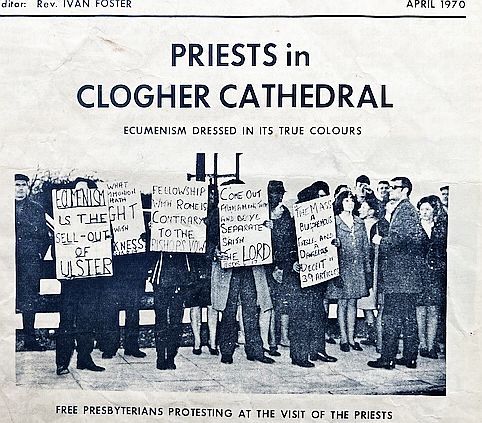
The protest took place at the installation of Richard Hanson as Bishop of Clogher, on March 17th, 1970.
The protest brought about the ejecting of us from of a local Orange Hall, Andrews Wood hall, where I was conducting a Gospel mission. The mission continued however, and by the end of April a Free Presbyterian hall had been erected and some months later that year, Clogher valley Free Presbyterian Church was constituted in the hall.
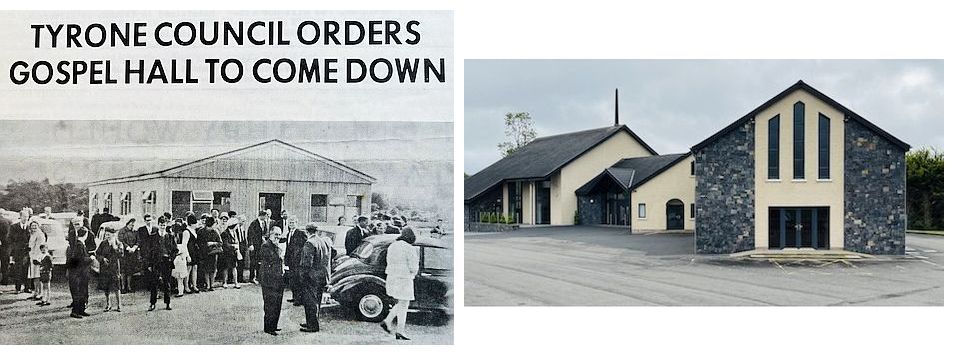
Despite the efforts of local ecumenists and their roping in of some Tyrone County Council officials to aid them, their demand that the hall be taken down and removed, failed.
It can be seen that a hall had been erected and was in use for regular services by June. Many years ago, the hall was replaced by a beautiful permanent building.
The Gospel outreach in the Spring of 1970 in Clogher Valley was the first of a number of missions undertaken by Lisbellaw Free Presbyterian Church that resulted in a permanent Gospel witness in the area.
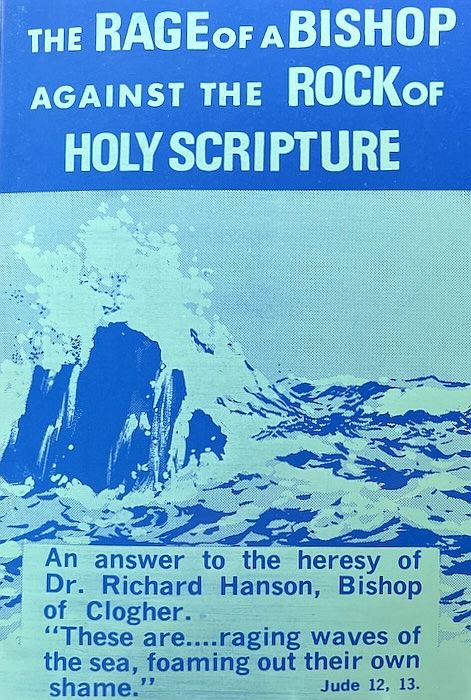
AN ANSWER TO FOUR LECTURES DELIVERED IN ENNISKILLEN CATHEDRAL BY THE BISHOP OF CLOGHER RICHARD HANSON
by
REV. IVAN FOSTER
Minister of Lisbellaw Free Presbyterian Church
Published as a booklet in 1970
The rage of the Bishop against the rock of Holy Scripture
Chapter IV
The Inspiration and Authority of the Bible
In his first lecture the Bishop seeks, as he tells us, to “clear the ground”. What the Bishop means by this is later revealed. He is out to remove from the people’s minds all “obstacles” to the introduction of his own doctrines. He commences this clearing operation with characteristic subtlety. He wanted to make it clear, we are told, that he “did not believe Christianity to be an entirely fluid thing wholly subject to changes in intellectual fashion, a matter of subjective opinion with no unchanging or eternal element in it”. Having thus reassured us with this statement he continues: “But” – and HERE COMES THE POISONED BARB – he was giving these lectures “in order to point out that Christianity in one sense always had changed, must be expected to go changing, and was manifestly changing at the present time”. He goes on to say: “What we think is good old Christianity, the genuine, original, unchanging faith -our faith, of course – almost certainly is not what the first Christians believed”. The Bishop tells the truth here – quite unintentionally, of course. HIS CHRISTIANITY IS NOT THE FAITH OF THE FIRST CHRISTIANS. What the Bishop is maintaining, of course, is that Christianity should NOT be expected to be the same as that of the early believers. There is nothing wrong with us believing something that they disbelieved or disbelieving what they believed. We can simplify the whole matter by saying the Bishop believes that Christians today are not tied to the Bible as the early Christians were.
Thus the clearing begins. He goes on now to finish the task by declaring: “Another important assumption which will govern these lectures is that the hypothesis that the Bible is accurate and exact and without mistakes in every sense in every part is an IMPOSSIBLE ONE”. So, step by step Dr. Hanson levers his audience away from the Bible. He seeks to destroy any tendency on the part of his audience to return to the Bible by stating that it is not without mistakes and errors. He gives us his opinion of the Bible. “THE DOCUMENTS OF THE BIBLE HAVE THE SAME HISTORICAL AUTHORITY AS SIMILAR DOCUMENTS OF THEIR TIME, NO MORE AND NO LESS.” There you have it. The site is clear now for the building of the Bishop’s edifice, a building that will consist of falsehoods and lies, deceptions and delusions, and which will fail its occupants on the great day of God’s wrath.
“Judgement also will I lay to the line, and righteousness to the plummet: and the hail shall sweep away the refuge of lies and the waters shall overflow the hiding place. And your covenant with death shall be disannulled, and your agreement with hell shall not stand; when the overflowing scourge shall pass through, then ye shall be trodden down by it” (Isaiah 28 : 17-18).
Theological acrobats
With deceptive benignity Dr. Hanson concludes: “This does not mean, it is perhaps necessary to add, that I reject the authority of the Bible, but I do not think that its authority is enhanced by the futile attempts to defend its inerrancy”. What utter balderdash and rank hypocrisy. The Bishop refers to what he mockingly calls the “sanctified dishonesty” of those who believe the Bible. What a Pharisee the man is to accuse any one of dishonesty! He accepts the authority of the Bible but does not believe it. The man is a self-confessed fool. How can you believe a book to be untruthful yet make it the authority of your life? Anyone who makes what he acknowledges as lies the ruling influence and authority of his life will practise deceit.
Like many before him the Bishop is attacking the inspiration of the Word of God. He states in his first lecture that the Bible contains “Inconsistencies, mistakes and contradictions”. He gives no examples as proof of these errors. Like the lover of Popery that he is, he seeks to emulate the little man from Rome. He simply speaks and “Lo, it is so”. If what Dr. Hanson says is true, it seems rather strange that there are still people in the world who not only believe the Bible but who are imprisoned because of their allegiance to it and are indeed willing to shed their life’s blood rather than surrender their faith in it. Here in Ulster the number of Bible-believers is increasing. Praise God in Lisbellaw and in Clogher Valley Free Presbyterian churches alone there have been souls brought to a knowledge of Christ and to a love of His Word. This has taken place right under the Bishop’s ecumenical nose.
How is it that despite the constant attack upon the infallibility of God’s Word from “snakes in the grass” preachers and blaspheming advocates of wickedness on radio and television this Book stands like a rock amidst the seas of man’s enmity? Why? Because it is the Word of God. This is the only conclusion one can draw from the indestructibility of the Bible.
“For all flesh is as grass, and all the glory of man as the flower of grass. The grass withereth, and the flower thereof falleth away: but the word of the Lord endureth for ever. And this is the word that by the gospel is preached unto you” (I Peter 1 : 24-25).
Dr. Ian Paisley in his book Christian Foundations, aptly states the case of the indestructibility of the Bible.
“The greatest fact of all time is the Bible. How a Book which has been so universally attacked could survive and attain to such a place of eminence is a miracle eloquently testifying to its supernatural origin.
Because the Bible forthrightly condemns sin, the hatred of sinners has been hurled against it. Because the Bible in plain and unmistakable language debases the pride of man, proud man, has set himself the task to discredit it. Because the Bible uncovers the satanic underworld it is the object of the diabolical attacks of hell. Because the Bible declares that salvation is by grace alone all false religions have sought to extinguish it.
The Bible condemns every man and condones no man; it accuses every man and excuses no man; it abases human reason and exalts revelation; it repudiates the natural and rejoices in the spiritual, glorying not in flesh but in faith.
Attacked from all quarters and giving no quarter, the Bible has an Ishmaelite experience, its hand is against every man and every man’s hand is against it, but wonder of wonders, it continues to dwell in the midst of brethren.
Princes, philosophers, prelates, politicians and poets have all conspired against it. It has been insulted by the scorn of fools. It has become the jest of infidels and the joke of sceptics. It has been assailed consistently and persistently by professed scholars and has been made the butt of the critic. Assaulted by every known plan of hell, it has come forth unscathed from the inferno. Like the three Hebrew children it has been in the fire, and like them it has been wonderfully preserved, and there is not a smell of burning upon it.
The fire has yet to be lit that can destroy it. The steel has yet to be forged that can scar it. The weapon has yet to be devised that can overthrow it. The scholarship has yet to be developed that can discredit it. The sciences have yet to be created that can demolish it. The plan has yet to be devised that can annihilate it.
The cunning of hell and the craft of earth have combined against the Bible, but it stands unmoved, for it is as W. E. Gladstone, one of England’s greatest Premiers, has described it, the impregnable rock of Holy Scripture.
As the Bible has stood the hottest broadsides of hell, it will not be affected by the pop-guns of modernism.
In the past century Voltaire thought he had demolished it and boasted that in one hundred years Christianity would be a museum piece. As a result, infidelity ran riot in France. Voltaire, however, passed screaming into eternity, but the Bible has not passed away. Moreover, Voltaire’s printing press was used to print the very Scriptures which he boasted he had demolished, and his house became a depot for the Geneva Bible Society.
“Will the Old Book stand?”
Will the Old Book stand when the “higher critic” state
That grave errors are discovered on its page?
Will it save the sinful soul? Will it make the wounded whole?
Will its glorious truth abide from age to age?
Will its message still abide, when the scientists decide
That its record of Creation is untrue?
Tell us the ascent of man is by evolution’s plan;
Will its principles the sinful heart renew?
When in language wondrous fair, “Christian scientists” declare
That there is no evil, only mortal mind,
When mental treatment fails, and seeming death prevails,
May we in the Bible consolation find?
When infidels parade the mistakes which Moses made,
When the truth of Revelation they deny,
Will the Ten Commandments still the demands of justice fill?
Will its word support us when we come to die?
Yes, the Word of God shall stand, though assailed on every hand,
Its foundations are eternally secure;
It will bear the critics’ test and the idle scoffer’s jest,
Its saving truth for ever shall endure.
So I believe the Bible is the Word of God because it remains with the passing and injuries of time, a temple unprofaned by the foot of the enemy, a building of God, amidst the crumbling ruins of the centuries.”
The Bible is an indestructible Book because it is a Divine Book. Its message is the message of God. “For the prophecy came not in old time by the will of man: but holt men of God spake as they were moved by the Holy Ghost” (II Peter 1 : 21). The Bible is an authoritative revelation to us from God in which God’s thoughts are conveyed to us with infallible accuracy and the very words which clothe the thoughts are from God Himself. This is what is known as verbal inspiration.
Let me quote one great statement which sets out the historic Protestant belief in regard to the Bible. It is from the pen of Charles Haddon Spurgeon, rightly acclaimed as the Prince of Preachers. After his withdrawal from and censure by the modernistic Baptist Union of Great Britain and Ireland and a little time before his call to higher service, Mr Spurgeon, along with six like-minded brethren, drew up a doctrinal statement which they called “A Confession”. This confession contained the following concise statement on the Inspiration of the Bible:
“We the undersigned, banded together in fraternal union, observing with growing pain and sorrow the loosening hold of many upon the truths of Revelation, are constrained to avow our firmest belief in the verbal inspiration of all Holy Scripture as originally given. To us, the Bible does not merely contain the Word of God, but it is the Word of God. From beginning to end, we accept it, believe it, and continue to preach it. To us, the Old Testament is no less inspired than the New, the Book is an organic whole. Reverence for the New Testament accompanied by skepticism as to the Old appears to us absurd. The two must stand or fall together. We accept Christ’s own verdict concerning “Moses and all the prophets” in preference to any of the supposed discoveries of so-called higher criticism.”
It is clear from a study of the language of the Lord that He believed in verbal inspiration. In confounding the Sadducees He built the doctrine of the immortality of the spirit and the resurrection of the body on the tense of the verb “to be”. He drew attention to the Bible statement, “I AM the God of Abraham, Isaac and Jacob”, and not that God WAS the God of Abraham, Isaac and Jacob. (Matt. 22 : 32).
Again, in Matthew 5 : 18 He emphasised that inspiration extended to the smallest Hebrew letter, the jot, and to the smallest distinguishing mark, the tittle. “For verily I say unto you, Till heaven and earth pass, one jot or one tittle shall in no wise pass from the law, till all be fulfilled.”
To sum up, all Scripture is inspired of God (II Tim. 3 : 16); the writers are inspired of God (II Peter 1 : 21); every letter is also inspired (Gal. 3 : 16), and inspiration extends to every jot and tittle (Matt. 5 : 18).
No better testimony to the extent of inspiration could be borne than that by Dean Burgon:
“The Bible is none other than the voice of Him that sitteth on the throne. Every book of it, every chapter of it, every verse of it, every syllable of it, every letter of it, is the direct utterance of the Most High.”
Unlike the Clogher Bishop, who accepts the authority but rejects the Divine Authorship, we accept the authority of the Bible because it is THE WORD OF GOD.
Saturday 27th June, 2026
Part 6 will follow next Saturday DV.