
 I downloaded the following document from a Free Presbyterian Church website yesterday.
I wish to set before the Moderator and the Clerk of our Presbytery and the readership of ‘The Burning Bush’, two points from the ‘Statement on Ecclesiastical Separation’ as issued by our Presbytery, and to ask some questions which arise with regards recent procedures sanctioned by the Presbytery.
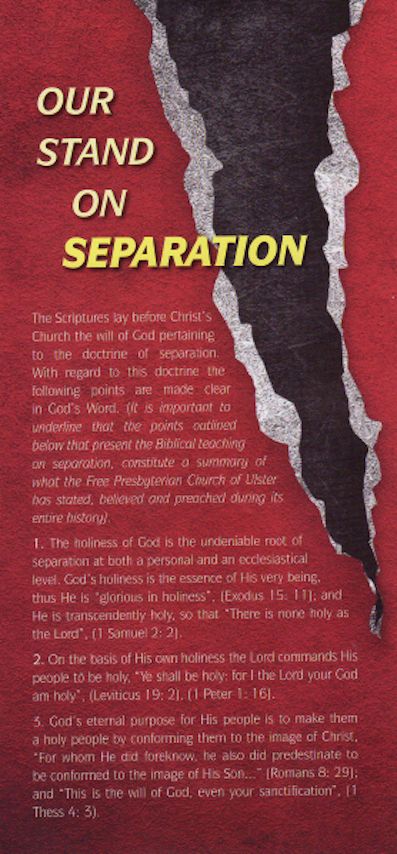
FPC Position on Ecclesiastical Separation
Statement from the Free Presbyterian Church in Ulster General Presbytery
OUR STAND ON SEPARATION
The Scriptures lay before Christ’s Church the will of God pertaining to the doctrine of separation. With regard to this doctrine the following points are made clear in God’s Word. (It is important to underline that the points outlined below that present the Biblical teaching on separation, constitute a summary of what the Free Presbyterian Church of Ulster has stated, believed and preached during its entire history).
The following is a notice of an amendment I submitted to the Presbytery back in 1998, in the days when Dr Paisley was Moderator.
“October 1998 Notice of Motion
Rev I Foster proposed the following notice of motion: Reaffirmation of our stand on separation from Ecumenism.
“That this Presbytery reaffirms its opposition to the modern Ecumenical Movement and reiterates its call to God’s people to separate from all forms of fellowship with this end-time apostasy.
Furthermore, in keeping with our position on Ecumenism, the Presbytery calls upon all ministers, elders and members of committees, irrespective of their civic duties, to refrain from attendance at or participation in any ecumenical community service, especially those that have followed in the wake of recent terrorist bombings since such gatherings have clearly become an effective means of advancing and strengthening the cause of ecumenism and must not, therefore, have any form of endorsement from Free Presbyterians”.
Rev Foster stated he did not feel that as a denomination we were tottering on the edge of compromise. However, he reminded members that in scripture we often read of God’s people reaffirming their position. He said, “In the wake of recent bombings tremendous pressure had been exerted by Ecumenical churches on the Protestant people, especially those who hold civic office.”
He stated he felt it was wrong for Free Presbyterians to attend Ecumenical services no matter where they were held. Priests of Rome he said were brought onto platforms and accepted as ministers of Christ. He felt there was need to raise a banner high for all to see and for sessions to take note that they are to be guardians of our stand.
He asked that if agreed the motion should be carried in our magazines and as we are approaching Reformation Sunday ministers preach on the issue.
Clarification was sought as to what constituted an ecumenical civic service. The question of participation in Remembrance services and services of the Loyal Orders was raised. The Moderator stated he considered it was one organised by the clergy of the town for the purpose of promoting ecumenism. He said that with that interpretation put on the motion he would support it. Upon being seconded by Rev. T. Baxter the motion was adopted. It was agreed that an advert reaffirming our opposition to Romanism and Ecumenism should be placed in the newspaper.’
The are two points I wish to draw attention to from the document, ‘Our Stand on Separation’. They are numbers 9 and 10, which read:—
9. Thus, God’s call to separate means that a particular church is to separate from all participation or co-operation in worship or ministry with churches, organisations or individuals that have apostasised through denial of the fundamental truths of the Christian faith, (see 2 Cor 6: 14-18, Eph 5: 11, 1 Tim 6: 3-5).
10. They are also called to separate from brethren who maintain fellowship with those who deny the faith, (2 Thess 3: 6, 14-15); to repudiate unscriptural ecumenism and ecumenical evangelism; and to refuse to compromise any essential truth of the gospel in an effort to pursue and gain visible church union with degenerate churches, (see Prov 23: 23, Amos 3: 3, 2 John 9-11).
The Scriptures referred in these two points are:
“Be ye not unequally yoked together with unbelievers: for what fellowship hath righteousness with unrighteousness? and what communion hath light with darkness? And what concord hath Christ with Belial? or what part hath he that believeth with an infidel? And what agreement hath the temple of God with idols? for ye are the temple of the living God; as God hath said, I will dwell in them, and walk in them; and I will be their God, and they shall be my people. Wherefore come out from among them, and be ye separate, saith the Lord, and touch not the unclean thing; and I will receive you, And will be a Father unto you, and ye shall be my sons and daughters, saith the Lord Almighty,” 2 Corinthians 6:14-18.
“And have no fellowship with the unfruitful works of darkness, but rather reprove them,” Ephesians 5:11.
“If any man teach otherwise, and consent not to wholesome words, even the words of our Lord Jesus Christ, and to the doctrine which is according to godliness; He is proud, knowing nothing, but doting about questions and strifes of words, whereof cometh envy, strife, railings, evil surmisings, Perverse disputings of men of corrupt minds, and destitute of the truth, supposing that gain is godliness: from such withdraw thyself,” 1 Timothy 6:3-5.
“Now we command you, brethren, in the name of our Lord Jesus Christ, that ye withdraw yourselves from every brother that walketh disorderly, and not after the tradition which he received of us. . . . And if any man obey not our word by this epistle, note that man, and have no company with him, that he may be ashamed. Yet count him not as an enemy, but admonish him as a brother,” 2 Thessalonians 3:6, 14-15.
“Buy the truth, and sell it not; also wisdom, and instruction, and understanding,” Proverbs 23:23.
“Can two walk together, except they be agreed?” Amos 3:3.
“Whosoever transgresseth, and abideth not in the doctrine of Christ, hath not God. He that abideth in the doctrine of Christ, he hath both the Father and the Son. If there come any unto you, and bring not this doctrine, receive him not into your house, neither bid him God speed: For he that biddeth him God speed is partaker of his evil deeds,” 2 John 1:9-11.
These Scriptures will be familiar to readers of ’The Burning Bush’, since I frequently quote them in articles on ‘Separation’!
Two questions arose in my mind as I read this document.
1. When did Rev Ron Johnstone and Rev William McCrea obtain leave to totally ignore what this document issued by the Presbytery states is ‘the Biblical teaching on separation’?
(See ‘A very public rebuke!’ and ‘The slide accelerates!’)
2. Why was Rev Ron Johnstone granted permission to make a statement of complaint against me, in defiance of Rule 10.5 of the Book of Church Order;
and why was I then investigated by a Commission of Presbytery, set up in response to Rev Johnstone’s statement of complaint before the Presbytery, since I was merely pointing out in an article (‘Unambiguous witness or an uncertain sound — which?’), in total agreement with the Presbytery’s own statement on ‘Separation’, that he was wrong to fellowship with disobedient ‘evangelicals’ who defied God’s call to separate from the ecumenical apostasy?
What I criticised him for doing was that which is strictly forbidden in the Word of God and in this statement on separation issued by our Presbytery.
In so doing he sanctioned disobedience to God and encouraged others to act in like manner!
At least some of those who compiled this statement were present when the Presbytery agreed to set up a ‘Commission’ to investigate what I wrote. Why did they not say that my criticism was in agreement with the statement they had helped to compile?
Rev Ivan Foster (Rtd)
26th June 2026