
Some photographs from that time of contending for the Gospel
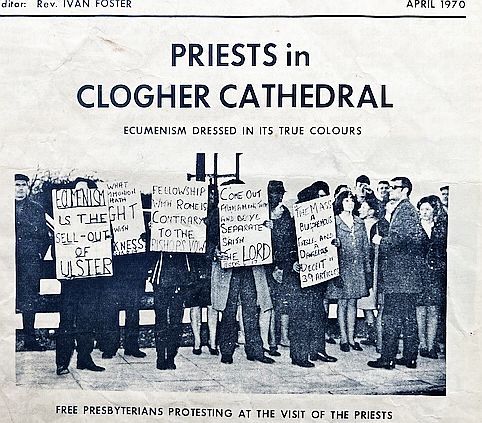
The protest took place at the installation of Richard Hanson as Bishop of Clogher, on March 17th, 1970.
The protest brought about the ejecting of us from of a local Orange Hall, Andrews Wood hall, where I was conducting a Gospel mission. The mission continued however, and by the end of April a Free Presbyterian hall had been erected and some months later that year, Clogher valley Free Presbyterian Church was constituted in the hall.
Despite the efforts of local ecumenists and their roping in of some Tyrone County Council officials to aid them, their demand that the hall be taken down and removed, failed.
It can be seen that a hall had been erected and was in use for regular services by June. Many years ago, the hall was replaced by a beautiful permanent building.
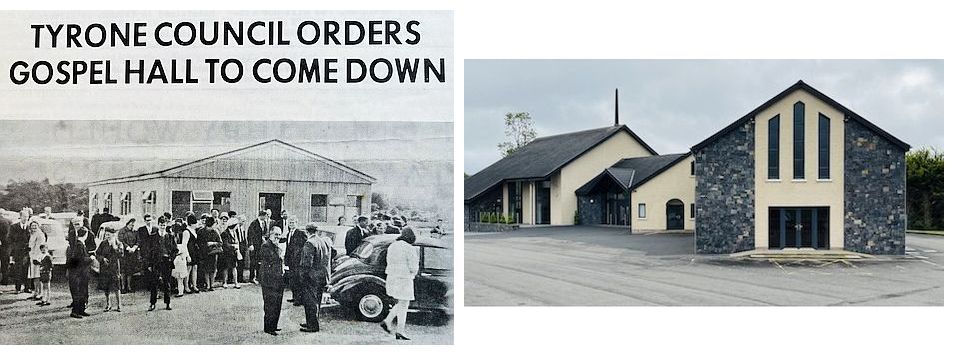
The Gospel outreach in the Spring of 1970 in Clogher Valley was the first of a number of missions undertaken by Lisbellaw Free Presbyterian Church that resulted in a permanent Gospel witness in the area.
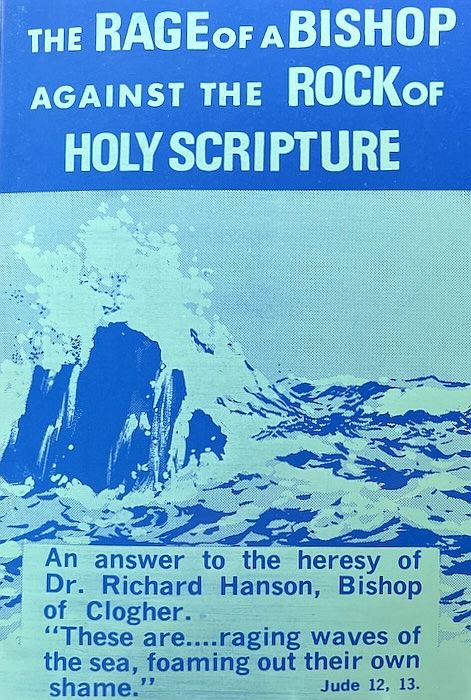
AN ANSWER TO FOUR LECTURES DELIVERED IN ENNISKILLEN CATHEDRAL BY THE BISHOP OF CLOGHER RICHARD HANSON
by
REV. IVAN FOSTER
Minister of Lisbellaw Free Presbyterian Church
Published as a booklet in 1970
The rage of the Bishop against the rock of Holy Scripture
Chapter VI
An Answer to the Bishop’s slander of the Reformation
It is on the subject of the Reformation that the Bishop once more gives us a display of his Jesuitry and cunning. We quote from his second lecture: “Now I want to look briefly at a period of change in Christianity which will probably be better known to the audience: the Reformation of the 16th century. We usually think of this as the period above all others of change in the Church and in Christianity”. We shall return for a moment to the Bishop’s discussion of the various changes, but firstly let us settle one question. Did Christianity and the Church change at the Reformation? Do not drink the Bishop’s proffered cup, for the keen eye will detect the taint of poison. The Reformation was a “time of change”, but the changes did not take place in the Church or in Christianity. By the “Church” I mean the unchanging and unchangeable religion of the Word of God.
The Bishop’s inventions
As we rake through the rubble of the Bishop’s collapsed intellectualism we constantly come across this one persistent falsehood. Varied may be its disguises, but its nature never changes. Dr. Hanson labours assiduously throughout these lectures to make “CHANGES” acceptable to his audience, and his readers. To do this he invents periods of change in the Church. The date and background for his “changes” are not chosen at random, but carefully. He first of all suggested that the 2nd century was a time of change, and so of course it was, but the changes were political and philosophical, not doctrinal. Empires may fall, philosophical theories perish, but the religion of God’s Word is unaffected in its intrinsic nature. Jesus said “Heaven and earth will pass away, but my word shall never pass away”.
Now again Dr. Hanson seeks to introduce another of these periods of change. Again he has carefully chosen his time and background. No one will deny that the 16th century saw many changes. BUT WE CONTEST HIS STATEMENT THAT THE CHANGES TOOK PLACE IN THE CHURCH AND IN CHRISTIANITY. The changes were men and women leaving the CHURCH OF ROME in their tens of thousands, and by the work of the Holy Spirit made members of the CHURCH OF GOD – “The church of the first-born, which are written in heaven” (Heb. 12:23). It was not changes in Christianity that took place, but men changing their God, changing from the God of popish Rome to the LIVING GOD OF THE BIBLE. There was no more a change in Christianity during the Reformation than there was when Paul preached in Thessalonica and “many turned to God from idols to serve the living and true God; and to wait for His Son from heaven, whom He raised from the dead, even Jesus, which delivered us from the wrath to come” (1 Thess, 1 : 9-10). The Reformation saw a MULTIPLICATION OF BELIEVERS, but NOT an ALTERATION OF BELIEF. With this fundamental fact in mind we shall examine the rest of the Bishop’s statement.
One of the results of the Reformation, he tells us, was that “it left a Church divided into fragments, some of them sharply opposed to the others”. Here the Romanist comes to the fore of Dr. Hanson’s character. “It left a Church divided”. This was the chant of super-ecumenist Pope John, which has been taken up by the like-minded deceivers. We need to remember that it was the false and idolatrous Church of Rome that was shattered. Dr. Hanson is insinuating that Martin Luther committed the sin of schism, i.e., withdrawing from God’s people. Martin Luther did not sin. He obeyed a Divine principle and SEPARATED FROM DARKNESS. The harm done by Martin Luther’s action can be likened unto the disturbance in the tomb of Lazarus when he rose from the dead, or to the bursting open of the graves by the dead raised at the time of Christ’s crucifixion.
THE LIVING LEFT THE PLACE OF DEATH AND DARKNESS. Who can blame them if their exit left the Church of Rome in confused fragments?Luther and the Reformers and their disciples left the stinking grave of Roman paganism with its rotten and corrupting practices. What was left were the rotten clods and mouldy bones of centuries of satanic darkness. The bleating and pleading of ten thousand Dr. Hansons shall not persuade us to return to the sepulchre of Rome, no matter how much paint has been applied to the outer walls or how many carpets have been laid over the unsavoury sight of soul-destroying doctrines and Bible-defying practices, or how well the smell of death, the death of countless multitudes of God’s dear saints, has been camouflaged with the scent spray of false ecumenical love. We shall resist the voice of the ecumenists and stand fast in the liberty wherewith Christ has made us free.
Reformers slandered
The Bishop is incredibly bitter against those who love God’s Word. However, he has learned not to be too severe in his use of words when criticising the Reformers. Enniskillen Cathedral must yet have a remnant with some respect for the names, if not the Gospel, of the Reformers. Nevertheless, the Bishop’s hatred comes across quite distinctly. He insinuates rather than plainly states that Martin Luther, John Calvin, etc., did great harm to the Church of Christ. He uses the words, ‘violent revolution’, ‘divided fragments’, ‘sharply opposed’, to give the impression that Calvin and Luther were DESTROYERS, not REFORMERS. Then lest any should ask, ‘But if they were wrong, what of the good work they commenced, bringing the light of God’s Word to the nations?’, the Bishop goes on in his lecture to belittle, deride and minimise the work of the Reformation. He says, ‘It is much too naive and simple to regard it (the Reformation) as a straightforward affair of going back to the doctrine of the primitive Church. Whatever else the major Reforming traditions achieved, they cannot be credited with having achieved a return to the Bible.’ Here is the lie of the slanderer. He denies the one thing of which history contains ample evidence. The Reformation saw the breaking forth of the healing waters of God’s eternal Word. Luther’s translation of the Scriptures into German was not only a means of unifying the many dialects of Germany into one common language, but it brought God’s Word within the reach of his nation. England, Scotland, Wales, France, Switzerland—who can number the nations which received God’s Word as a direct result of the Reformation? Yet BISHOP HANSON SAYS THEY DID NOT RETURN TO THE BIBLE.The Bibles in our homes, the Bible in his cathedral, the Bibles on open sale throughout the world, expose his lie.
Of course the Reformation is a great embarrassment to ecumenists. One cannot expect anything else from such lovers of Ritualism and popish paraphernalia. You see it proves that the Bible is the true source of a nation’s greatness and that Rome is the scourge of nations and the destroyer of national purity. ’Righteousness exalteth a nation’, said wise King Solomon in Proverbs 14:34; and the proof of this is the glorious Reformation of the 16th century. Before the Reformation there was a blanket of darkness and doubt, after it the blessing of light and life.
To further his purpose of destroying God’s Word the Bishop of Clogher must destroy this bright testimony to its holy influence. Like Jeroboam who feared the loss of the people’s support should they go up to worship at Jerusalem and there see the magnificent temple and be reminded of the glory of the Lord, so the Bishop seeks to extinguish this glorious witness of the Bible’s power.
Bishop J. C. Ryle
Listen to history’s record of the miraculous changes wrought by the breaking forth of the Gospel light. We quote from the book Five English Reformers, by J. C. Ryle, late Bishop of Liverpool. The reader can contrast for himself the writings of godly J. C. Ryle with the sentiments expressed by Dr. Hanson, the modernist.
(a) Before the Reformation, one leading feature of English religion was DENSE IGNORANCE. There was among all classes a conspicuous absence of all knowledge of true Christianity. A gross darkness overspread the land, a darkness that might be felt. Not one in a hundred could have told you as much about the Gospel of Christ as we could now learn from any intelligent Sunday School child.
We need not wonder at this ignorance. The people had neither schools nor Bibles. Wickliffe’s New Testament, the only translation extant till Henry VIII’s Bible was printed, cost £2 16s 3d of our money. The prayers of the Church were in Latin, and of course the people could not understand them. Preaching there was scarcely any. Quarterly sermons indeed were prescribed to the clergy, but not insisted on. Latimer says that while Mass was never to be left unsaid for a single Sunday, sermons might be omitted for twenty Sundays, and nobody was blamed. After all, when there were sermons they were utterly unprofitable: and latterly to be a preacher was to be suspected of being a heretic.
To cap all, the return that Hooper got from the diocese of Gloucester, when he was first appointed Bishop of 1551, will give a pretty clear idea of the ignorance of pre-Reformation times. Out of 311 clergy of the diocese 168 were unable to repeat the Ten Commandments; 31 of the 168 could not state in what part of Scripture they were to be found; 40 could not tell where the Lord’s Prayer was written; and 31 of the 40 were ignorant who was the author of the Lord’s Prayer!
If this is not ignorance, I know not what is. If such were the pastors, what must the people have been! If this was the degree of knowledge among the parsons, what must it have been among the people!
(b) But this is not all. Before the Reformation, another leading feature of English religion was SUPERSTITION OF THE LOWEST AND MOST DEGRADING DESCRIPTION. To the extent to which this was carried few, I suspect, have the smallest idea.
Men and women in those days had uneasy consciences sometimes, and wanted relief. They had sorrow and sickness and death to pass through, just like ourselves. What could they do? Whither could they turn? There was none to tell them of the love of God and the mediation of Christ, of the glad tidings of free, full, and complete salvation, of justification by faith, of grace, and faith, and hope, and repentance. They could only turn to the priests, who knew nothing themselves and could tell nothing to others. The blind led the blind, and both fell into the ditch. In a word, the religion of our ancestors before Hooper’s time was little better than an organised system of Virgin Mary worship, saint worship, image worship, relic worship, pilgrimages, almsgivings, formalism, ceremonialism, processions, prostrations, bowings, crossings, fastings, confessions, absolutions, masses, penances and blind obedience to the priests. It was a grand higgledy-piggledy of ignorance and idolatry, and service done to an unknown God by deputy. The only practical result was that the priests took the people’s money, and undertook to ensure their salvation; and the people flattered themselves that the more sure they were of going to heaven.
The catalogue of gross and ridiculous impostures which the priests practised on the people would fill a volume, and I cannot of course do more than supply a few specimens.
The blood of a duck
At the Abbey of Hales, in Gloucestershire, a vial was shown by the priests to those who offered alms, which was said to contain the blood of Christ. On examination, in Henry VIII’s time, this notable vial was found to contain neither more nor less than the blood of a duck, which was renewed every week.
At Bexley, in Kent, a crucifix was exhibited which received peculiar honour and large offerings because of a continual miracle which was said to attend its exhibiting. When people offered copper, the face of the figure looked grave; when they offered silver, it relaxed its severity; when they offered gold, it openly smiled. In Henry VIII’s time this famous crucifix was examined, and wires were found within it by which the priests could move the face of the image, and make it assume any expression that they pleased.
At Reading Abbey, in Berkshire, the following relics, among many others, were most religiously worshipped: an angel with one wing; the spearhead that pierced our Saviour’s side; two pieces of the holy cross; St. James’s hand; St. Philip’s stole, and a bone of Mary Magdalene.
At Bury St. Edmund’s, in Suffolk, the priests exhibited the coals that roasted St. Laurence; the parings of St. Edmund’s toe nails; Thomas à Becket’s penknife and boots, and as many pieces of our Saviour’s cross as would have made, if joined together, one whole cross.
At Maiden Bradley Priory, in Somersetshire, the worshippers were privileged to see the Virgin Mary’s smock; part of the bread used at the original Lord’s Supper, and a piece of the stone manger in which our Lord was laid at Bethlehem.
At Burton Priory, in Somersetshire, was kept a girdle of the Virgin Mary, made of red silk. This modern relic was sent as a special favour to women in childbirth to insure them a safe delivery. The like was done with a white girdle of Mary Magdalene, kept at Farley Abbey, in Wiltshire. In neither case may we be sure, was the relic sent without a pecuniary consideration.
(Strype and Burnet are my authority for the above-mentioned facts.)
Records like these are so silly and melancholy that one hardly knows whether to laugh or cry. But it is positively necessary to bring them forward in order that men may know what was the religion of our forefathers before the Reformation. Wonderful as these things may sound in our ears, we must never forget that Englishmen in those times knew no better. A famishing man, in sieges and blockades, has been known to eat mice and rats rather than die of hunger. A soul famishing for lack of God’s Word must not be judged too harshly, if it struggles to find comfort in the most grovelling superstition.
(c) One thing more yet remains behind. Before the Reformation, another leading feature of English religion was WIDESPREAD UNHOLINESS AND IMMORALITY. The lives of the clergy, as a general rule, were simply scandalous, and the moral tone of the laity was naturally at the lowest ebb. Of course, grapes will never grow on thorns, nor figs on thistles. To expect the huge roots of ignorance and superstition which filled our land to bear any but corrupt fruit would be unreasonable and absurd. But a more thoroughly corrupt set than the English clergy were, in the palmy days of undisturbed Romanism, it would be impossible to imagine.
I might tell you of the habits of gluttony, drunkenness and gambling, for which the parochial priesthood became unhappily notorious.
Too often, says Professor J. R. Blunt, in his excellent history of the Reformation, they were persons taken from the lowest of the people, with all the gross habits of the class from which they sprang—loiterers on the alehouse bench, dicers, scarce able to read by rote their paternoster, often unable to repeat the Ten Commandments; Mass-priests who could just read their breviaries and no more; men often dubbed by the uncomplimentary names of Sir John Lack-Latin, Sir John Mumble-Matins, or babbling blind Sir John. In fact, the carnal living, fat bellies and general secularity of ministers of religion were proverbial before the Reformation.
Public scorn
I might tell you of the shameless covetousness which marked the pre-Reformation priesthood. So long as a man gave liberal offerings at the shrine of such saints as Thomas à Becket, the clergy would absolve him of almost any sin. So long as a felon or malefactor paid the monks well, he might claim sanctuary within the precincts of religious houses, after any crime, and hardly any law could reach him. Yet all this time for Lollards and Wickliffites there was no mercy at all! The very carvings still extant in some old ecclesiastical buildings tell a story in stone and wood, which speaks volumes to this day. Friars were often represented as foxes preaching, with the neck of a stolen goose peeping out of the hood behind; as wolves giving absolution, with a sheep muffled up in their cloaks; as apes sitting by a sick man’s bed, with a crucifix in one hand and with the other in the sufferer’s pocket. Things must indeed have been at low ebb, when the faults of ordained ministers were so publicly held up to scorn.
But the blackest spot on the character of our pre-Reformation clergy in England is one of which it is painful to speak. I mean the impurity of their lives, and their horrible contempt of the Seventh Commandment. The results of auricular confession, carried on by men bound by their vows never to marry, were such that I dare not enter into them. The consequences of shutting up herds of men and women in the prime of life, in monasteries and nunneries, were such that I will not defile my reader’s mind by dwelling upon them. Suffice it to say that the discoveries made by Henry VIII’s Commissioners, of the state of things in many of the so-called ‘religious’ houses, were such as it is impossible to describe. Anything less holy than the practice of many of the holy retreats of sin and the world, the imagination cannot conceive! If ever there was a plausible theory weighed in the balance and found utterly wanting, it is the favourite theory that celibacy and monasticism promote holiness. Romantic young men and sentimental young ladies may mourn over the ruins of such Abbeys as Battle, and Glastonbury, and Bolton, and Kirkstall, and Furness, and Croyland, and Bury, and Tintern. But I venture boldly to say that too many of these religious houses were sinks of iniquity, and that too often monks and nuns were the scandal of Christianity.
I grant freely that all monasteries and nunneries were not equally bad. I admit that there were some religious houses like Godstow Nunnery, near Oxford, which had a stainless reputation. But I fear that these were bright exceptions which only prove the truth of the rule. The preamble of the Act for Dissolution of Religious Houses, founded on the report of Henry VIII’s Commissioners, contains broad, general statements that cannot be got over. It declares that ‘manifest sin, vicious, carnal, and abominable living is daily used and committed in abbeys, priories and other religious houses of monks, canons and nuns, and that albeit many continual visitations have been had, by the space of two hundred years and more, for an honest and charitable reformation of such unthrifty, carnal and abominable living, yet that nevertheless little or none amendment was hitherto had, but that their vicious living shamefully increased and augmented.’
Plain historical facts
After all, there is no surer receipt for promoting immorality than ‘fulness of bread and abundance of idleness’ (Ezekiel 16:49). Take any number of men and women, of any nation, rank or class; bind them by a vow of celibacy; shut them up in houses by themselves; give them plenty to eat and drink; and give them nothing to do; and above all, give them no Bible-reading, no true religion, no preaching of the Gospel, no inspection, and no check from public opinion; if the result of this be not abominable and abundant breach of the Seventh Commandment, I can only say that I have read human nature in vain.
I make no apology for dwelling on these things. Painful and humbling as the picture is, it is one that in these times ought to be carefully looked at, and not thrown aside. Before we join in the vulgar outcry which some modern Churchmen are making against the Reformation, I want English people to understand from what the Reformation delivered us. Before we make up our minds to give up Protestantism and receive back Popery and monasticism, let us thoroughly understand what was the state of England when Popery had its own way. My own belief is that never was a change so loudly demanded as the Reformation, and that never did men do such good service to England as Hooper and his fellow-labourers, the Reformers. In short, unless a man can disprove the plain historical facts recorded in the pages of Fox, Fuller, Strype, Burnet, Soames and Blunt, he must either admit that the pre-Reformation times were bad times, or be content to be regarded as a lunatic. To no class of men does England owe such a debt as to our Protestant Reformers, and it is a burning shame if we are ungrateful and refuse to pay that debt.
No doubt the work of the Reformation is not complete and never shall be until we see the Lord in all His glory. We have a great need today of reformation. Dead formalism has eaten the living heart out of many denominations. Dead ministers in the pulpit and dead office-bearers in the Churches have watered the message of the Gospel down, and in many places it is denied altogether. Those who love God’s truth need to follow Luther’s example and REFORM THEIR OWN LIVES by separating from sinful fellowship with unbelievers. (II Cor. 6:14-18.) Such action will be condemned, of course, by the Bishop Hansons of this world. Free Presbyterians can testify to this, but when you find him criticising Calvin and Luther, you only rejoice to be in such company.
Saturday 11th July, 2026
Final Part will follow next Saturday DV