
Some photographs from that time of contending for the Gospel
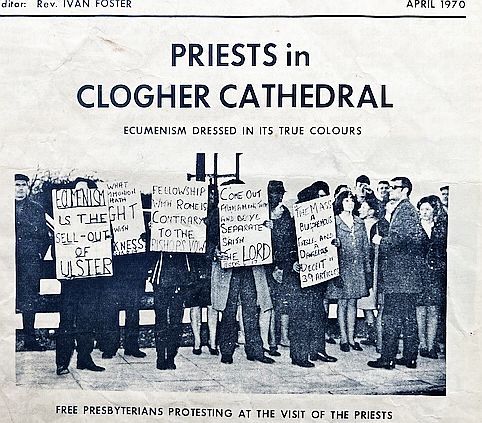
The protest took place at the installation of Richard Hanson as Bishop of Clogher, on March 17th, 1970.
The protest brought about the ejecting of us from of a local Orange Hall, Andrews Wood hall, where I was conducting a Gospel mission. The mission continued however, and by the end of April a Free Presbyterian hall had been erected and some months later that year, Clogher valley Free Presbyterian Church was constituted in the hall.
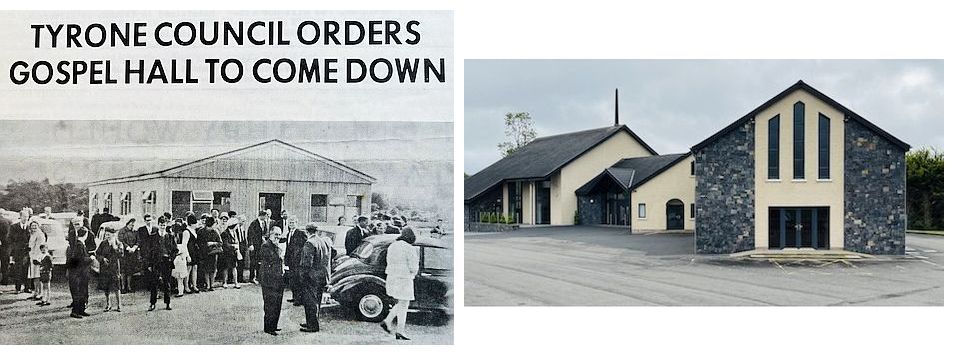
Despite the efforts of local ecumenists and their roping in of some Tyrone County Council officials to aid them, their demand that the hall be taken down and removed, failed.
It can be seen that a hall had been erected and was in use for regular services by June. Many years ago, the hall was replaced by a beautiful permanent building.
The Gospel outreach in the Spring of 1970 in Clogher Valley was the first of a number of missions undertaken by Lisbellaw Free Presbyterian Church that resulted in a permanent Gospel witness in the area.
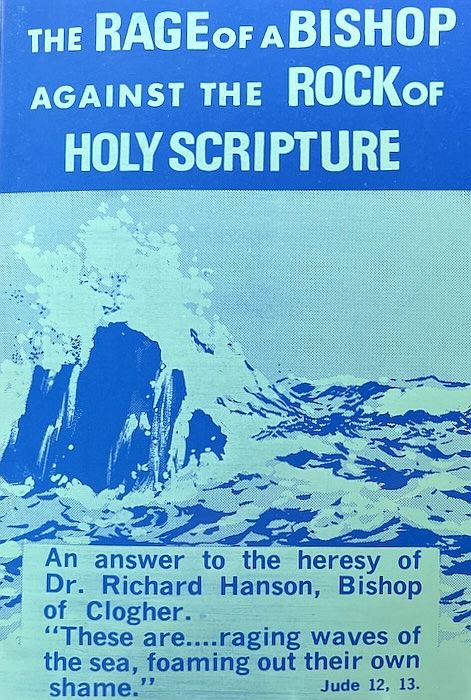
AN ANSWER TO FOUR LECTURES DELIVERED IN ENNISKILLEN CATHEDRAL BY THE BISHOP OF CLOGHER RICHARD HANSON
by
REV. IVAN FOSTER
Minister of Lisbellaw Free Presbyterian Church
Published as a booklet in 1970
The rage of the Bishop against the rock of Holy Scripture
Chapter II
The Bishop’s Yardstick
Before we consider the conclusions (or should we say confusions) the Bishop comes to, we would do well to consider the principles by which he made his judgments. We quote from his first lecture. ‘Next, I want to give an account of the criteria (standard by which he will decided what is good and what is bad) which I am going to use in these lectures…The first pole is the faith of the individual believer and of the Church…The other criterion which I shall use is… the verdict of historical and theological scholarship.’ The Bishop then is guided by what is acceptable to the Church today and what is acceptable to the theological scholars of today and yesterday. But does it not matter what the Bible says we should believe? NOT TO THE BISHOP. You see, we (in this new and changed world of the Bishop’s making) are going to be given from the Bible that which has first of all passed the test of the theologians of ecumenism. In other words the Bishop would place us in the yoke of bondage which Luther and an enlightened Europe cast off at the Reformation. THE BISHOP WOULD HAVE US ACCEPT THE POPISH DOCTRINE OF SUBMISSION TO THE CHURCH AND NOT TO THE WORD OF GOD ON MATTERS OF FAITH AND PRACTICE. The cry of Fermanagh Protestants to the Bishop and his fellow-Romanisers is a long and loud ‘NO POPERY’!
Broken vow
Dr. Hanson swore at his ordination that his standard of faith was the Word of God. He has only recently changed his mind, because he swore the oath in the spring of 1970. Such is the hypocrisy and dishonesty of ecumenists. God’s Word says, ‘To the law and to the testimony: if they speak not according to this word, it is because there is no light in them.’ (Isaiah 8:20.) The Bishop has put the cart before the horse. We do not judge the Bible by the scholars, but the scholars by the Bible. It is God’s Word by which we judge the words of men.
If the Bishop were to preach the Word of God rather than damn his soul by seeking to pick holes in it he would be of more benefit to his diocese with its darkness and sin—darkness and sin which originates from Bible-rejecting and blind clerics.
We quote at length from the writings of a former Bishop of Liverpool, Dr. J.C. Ryle. Dr.J.C Ryle was a man who loved the souls of men dearly and coveted them for his Master. The quotation is taken from his lecture on the words of Paul found in Hebrews. 13:9. ‘Be not carried about with divers and strange doctrines.’ I beg the reader to carefully consider the words of the good and godly Bishop.
“The meaning of these words is not a hard thing which we cannot understand. ‘Be not tossed to and fro’, the Apostle seems to say, ‘by every blast of false teaching, like ships without a compass or rudder. False doctrines will arise as long as the world lasts, in number many, in minor details varying, in one point alone always the same—strange, new, foreign, and departing from the Gospel of Christ. They do exist now. They will always be found within the visible Church. Remember this and be not carried away.’ Such is St.Paul’s warning.
The Apostle’s warning does not stand alone. Even in the midst of the Sermon on the Mount there fell from the loving lips of our Saviour a solemn caution: ‘Beware of false prophets, which come unto you in sheep’s clothing, but inwardly they are ravening wolves’ (Matt 7:15). Even in St Paul’s last address to the Ephesian elders, though he finds no time to speak about the Sacraments, he does find time to warn his friends against false doctrine: ‘Of your own selves shall men arise, speaking perverse things to draw away disciples after them’ (Acts 20:30). What says the Second Epistle to the Corinthians?— ‘I fear, lest by any means, as the serpent beguiled Eve through his subtlety, so your minds should be corrupted from the simplicity that is in Christ’ (II Cor. 11:3). What says the Epistle to the Galatians?— ‘I marvel that ye are so soon removed from him that called you into the grace of Christ unto another gospel’. ‘Who hath bewitched you that ye should not obey the truth?’ ‘Having begun in the Spirit, are ye now made perfect by the flesh?’ ‘How turn ye again to the weak and beggarly elements,?’ ‘Ye observe days, and months, and times, and years. I am afraid of you’ ‘Stand fast therefore in the liberty wherewith Christ hath made us free, and be not entangled again with the yoke of bondage.’ (Galatians 5:1, AV)(Gal. 1:6; 3:1; 3; 4:9-11; 5:1.) What says the Epistle to the Colossians?— ‘Beware lest any man spoil you through philosophy and vain deceit, after the tradition of men’. (Col. 2:8.) What says the First Epistle to Timothy?— ‘The Spirit speaketh expressly, that in the latter times some shall depart from the faith’ (I Tim. 4:1). What says the Second Epistle of Peter?— ‘There shall be false teachers among you, who privily shall bring in damnable heresies’ (II Peter 2:1). What says the First Epistle of John?— ‘Believe not every spirit. Many false prophets are gone out into the world’ (I John 4:1). What says the Epistle of Jude?: ‘Contend earnestly for the faith once delivered to the saints. For there are certain men crept in unawares’ (Jude 1:3-4). Let us mark these texts well. These things were written for our learning.
Abundant errors
What shall we say to these texts? How they may strike others I cannot say. I only know how they strike me. To tell us, as some do, in the face of these texts, that the early Churches were a model of perfection and purity is absurd. Even in Apostolic days, it appears, there were abundant errors both in doctrine and practice. To tell us, as others do, that clergymen ought never to handle controversial subjects, and never to warn their people against erroneous views, is senseless and unreasonable. At this rate we might neglect not a little of the New Testament. Surely the dumb dog and the sleeping shepherd are the best allies of the wolf, the thief and the robber? It is not for nothing that St. Paul says, ‘If thou put the brethren in remembrance of these things, thou shalt be a good minister of Jesus Christ’ (I Tim. 4:5).
A plain warning against false doctrine is specially needed in England in the present day. (Approximately 100 years ago. The need has greatly increased.) The school of the Pharisees, and the school of the Sadducees, those ancient mothers of all mischief, were never more active than they are now. Between men adding to the truth on one side, and men taking away from it on the other; between those who bury truth under additions, and those who mutilate it by subtractions; between superstition and infidelity; between Romanism and neology; between Ritualism and Rationalism; between these upper and nether millstones the Gospel is well-nigh crushed to death.
STRANGE VIEWS ARE CONTINUALLY PROPOUNDED BY CLERGYMEN ABOUT SUBJECTS OF THE DEEPEST IMPORTANCE. ABOUT THE ATONEMENT, THE DIVINITY OF CHRIST, THE INSPIRATION OF THE BIBLE, THE REALITY OF MIRACLES, THE ETERNITY OF FUTURE PUNISHMENT; ABOUT THE CHURCH, THE MINISTERIAL OFFICE, THE SACRAMENTS, THE CONFESSIONAL, THE HONOUR DUE TO THE VIRGIN, PRAYERS FOR THE DEAD; ABOUT ALL THESE THINGS THERE IS NOTHING TOO MONSTROUS TO BE TAUGHT BY SOME ENGLISH MINISTERS IN THESE LATTER DAYS. BY THE PEN AND BY THE TONGUE, BY THE PRESS AND BY THE PULPIT, THE COUNTRY IS INCESSANTLY DELUGED WITH A FLOOD OF ERRONEOUS OPINIONS. TO IGNORE THE FACT IS MERE AFFECTATION. OTHERS SEE IT, IF WE PRETEND TO BE IGNORANT OF IT. THE DANGER IS REAL, GREAT AND UNMISTAKABLE. NEVER WAS IT SO NEEDFUL TO SAY ‘BE NOT CARRIED ABOUT’.
Modern false teachers
Many things combine to make a present inroad of false doctrine peculiarly dangerous. There is an undeniable zeal in some of the teachers of error: their ‘earnestness’ (to use an unhappy cant phrase) makes many think they must be right. THERE IS A GREAT APPEARANCE OF LEARNING AND THEOLOGICAL KNOWLEDGE: MANY FANCY THAT SUCH CLEVER AND INTELLECTUAL MEN MUST SURELY BE SAFE GUIDES. There is a general tendency to free thought and free inquiry in these latter days: many like to prove their independence of judgement by believing novelties. There is a widespread desire to appear charitable and liberal-minded: many seem half ashamed of saying that anybody can be in the wrong. There is a quantity of half-truth taught by the modern false teachers: they are incessantly using Scriptural terms and phrases in an unscriptural sense. There is a morbid craving in the public mind for a more sensuous, ceremonial, sensational, showy worship: men are impatient of inward, invisible heart-work. There is a silly readiness in every direction to believe everybody who talks cleverly, lovingly and earnestly, and a determination to forget that Satan is often ‘transformed into an angel of light’ (II Cor. 2:14). There is a widespread ‘gullibility’ among professing Christians: EVERY HERETIC WHO TELLS HIS STORY PLAUSIBLY IS SURE TO BE BELIEVED, AND EVERYBODY WHO DOUBTS HIM IS CALLED A PERSECUTOR AND A NARROW MINDED MAN. All these things are peculiar symptoms of our times. I defy any observing man to deny them. They tend to make the assaults of false doctrine in our day peculiarly dangerous. They make it more than ever needful to cry aloud, ‘Be not carried about’.
Does anyone ask me, what is the best safeguard against false doctrine? I answer in one word—- ‘The Bible: the Bible regularly read, regularly prayed over, regularly studied’. WE MUST GO BACK TO THE OLD PRESCRIPTION OF OUR MASTER: ‘SEARCH THE SCRIPTURES’ (John 5:39). If we want a weapon
to wield against the devices of Satan, there is nothing like ‘the sword of the Spirit, the Word of God.’ But to wield it successfully we must read it habitually, diligently, intelligently and prayerfully. This is a point on which, I fear, many fail. In an age of hurry and bustle, few read their Bibles as much as they should. More books perhaps
are read than ever, but less of the one Book which makes man wise unto salvation. Rome and neology could never have made such havoc in the Church in the last fifty years if there had not been a most superficial knowledge of the Scriptures throughout the land. A Bible reading laity is the strength of a Church.
Overwhelming mass of evidence
‘Search the Scriptures. Mark how the Lord Jesus Christ and His Apostles continually refer to the Old Testament, as a document just as authoritative as the New. Mark how they quote texts from the Old Testament, as the voice of God, as if every word was given by inspiration. Mark how the greatest miracles in the Old Testament are all referred to in the New, as unquestioned and unquestionable facts. Mark how all the leading events in the Pentateuch are incessantly named as historical events, whose reality admits of no dispute.
Mark how the atonement, and substitution, and sacrifice, run through the whole Bible from first to last, as essential doctrines of revelation. Mark how the resurrection of Christ the— greatest of all miracles is proved by such an overwhelming mass of evidence, that he who disbelieves it may as well say he will believe no evidence at all. Mark all these things and you will find it very hard to be a Rationalist! Great are the difficulties of infidelity: it requires more credulity to be an infidel than a Christian. But greater still are the difficulties of Rationalism. Free handling of Scripture–-results of modern criticism —broad and liberal theology—all these are fine, swelling, high-sounding phrases, which please some minds and look very grand at a distance. But the man who looks below the surface of things will soon find that there is no sure standing-ground between ultra-Rationalism and Atheism.
‘Search the Scriptures.’ Mark what a conspicuous absence there is in the New Testament of what may be called the Sacramental system, and the whole circle of Ritualistic theology. Mark how extremely little there is said about the effects of Baptism. Mark how very seldom the Lord’s Supper is mentioned in the Epistles. Find, if you can, a single text in which New Testament ministers are called sacrificing priests; or the Lord’s Supper is called a sacrifice; or private confession to ministers is recommended and practised. Turn, if you can, to one single verse in which sacrificial vestments are named as desirable; or in which lighted candles and pots of flowers on the Lord’s Table; or processions and incense, and flags and banners, and turning to the east, and bowing down to the bread and wine; or prayers to the Virgin Mary and the angels are sanctioned. Mark these things well and you will find it very hard to be a Ritualist! YOU MAY FIND YOUR AUTHORITY FOR RITUALISM IN GARBLED QUOTATIONS FROM THE FATHERS; IN LONG EXTRACTS FROM MONKISH, MYSTICAL OR POPISH WRITERS; BUT YOU CERTAINLY WILL NOT FIND IT IN THE BIBLE. Between the plain Bible, honestly and fairly interpreted, and extreme Ritualism, there is a gulf which cannot be passed.
If we would not be carried about by ‘divers and strange doctrines’, we must remember the words of our Lord Jesus Christ: ‘Search the Scriptures’. IGNORANCE OF THE BIBLE IS THE ROOT OF ALL ERROR. KNOWLEDGE OF THE BIBLE IS THE BEST ANTIDOTE AGAINST MODERN HERESIES. (Divers and strange doctrines – ‘KNOTS UNTIED’ by J C Ryle).
Part 4 will follow next Saturday DV.