Archives for

Article

‘Frogs in the Bed and Lice in the Hair’

“And in very deed for this cause have I raised thee up, for to shew in thee my power; and that my name may be declared throughout all the earth,” Exodus 9:16. 

Preached by Rev. Ivan Foster on Lord’s Day, March 2 1986.


Here is, at least to some small measure, the faith and hope of Free Presbyterians some 40 years ago.

Is something of the same message preached today in our pulpits? The denouncing of ecumenical treachery and betrayal of God’s truth; the same protest against the political compromising in the face of  Romanism’s, ecclesiastical and political, resurgence?

Or are there many of our pulpits silent on such matters and are there ministers who seek fellowship with those, described in our Presbytery’s statement, entitled: ‘OUR STAND ON SEPARATION’, as ‘brethren who maintain fellowship with those who deny the faith.’

If this is so, what a dishonouring of the God who has been so merciful to us as a denomination and what a judgment we will most surely face if there is not a repenting and turning back again to the ‘Old Paths’ of Scriptural obedience!

Rev Ivan Foster (Rtd)
Thursday 2nd July 2026

Darkness, dawn & deliverance

“Arise, shine; for thy light is come, and the glory of the LORD is risen upon thee. For, behold, the darkness shall cover the earth, and gross darkness the people: but the LORD shall arise upon thee, and his glory shall be seen upon thee. And the Gentiles shall come to thy light, and kings to the brightness of thy rising. Lift up thine eyes round about, and see: all they gather themselves together, they come to thee: thy sons shall come from far, and thy daughters shall be nursed at thy side,” Isaiah 60:1-4.

One thing is ever a source of displeasure when I turn to a chapter like Isaiah 60! It is the notes that most publishers of the Holy Scriptures have placed above the chapter in an attempt to supposedly help the reader understand its contents.

However, when it comes to prophetic chapters, the notes are too often erroneous and most misleading!

In my Bible the notes above Isaiah 60 read:—

1. The glorious access of the Gentiles into the church.
15. The blessings of the church after affliction.

These words are utterly wrong. This chapter is not about what happened after the crucifixion of Christ and the Gospel outreach which followed Pentecost. No, it is dealing with the conversion and the restoration of Israel to God’s favour and blessing at the second coming of Christ and what follows that glorious event amongst the Gentile nations.

Not the Church

Some verses plainly indicate that it is not the church but Israel that is referred to.

“And the sons of strangers shall build up thy walls, and their kings shall minister unto thee: for in my wrath I smote thee, but in my favour have I had mercy on thee,” Isaiah 60:10.

The redeemed people of God, the church, has never been subject to wrath! Chastening yes, but WRATH, no!

“For whom the Lord loveth he chasteneth, and scourgeth every son whom he receiveth. If ye endure chastening, God dealeth with you as with sons; for what son is he whom the father chasteneth not? But if ye be without chastisement, whereof all are partakers, then are ye bastards, and not sons,” Hebrews 12:6-8.

“As many as I love, I rebuke and chasten: be zealous therefore, and repent,” Revelation 3:19.

“Therefore being justified by faith, we have peace with God through our Lord Jesus Christ,” Romans 5:1.

“There is therefore now no condemnation to them which are in Christ Jesus, who walk not after the flesh, but after the Spirit,” Romans 8:1.

Judgment

However, God’s wrath has rested upon Israel ever since they rejected the Lord Jesus Christ, their Messiah. That which they had experienced in a measure under the Babylonian captivity has been their experience to a much greater degree since their rebellion and rejection of their Messiah.

“And the heathen shall know that the house of Israel went into captivity for their iniquity: because they trespassed against me, therefore hid I my face from them, and gave them into the hand of their enemies: so fell they all by the sword. According to their uncleanness and according to their transgressions have I done unto them, and hid my face from them,” Ezekiel 39:23-24.

Those words were written around 587 BC, and were a foretaste of that which would follow their even greater wickedness in the rejection and crucifixion of the Messiah.

Since AD 70, and the fall of Jerusalem and the destruction of the temple and the scattering of the nation, the Jew has been an outcast until this day. (more…)

70 years later – Can Ulster be saved again?

Notes of a message preached in Kilskeery Free Presbyterian Church — September 26th, 1982.

“And there came out against them Zerah the Ethiopian with an host of a thousand thousand, and three hundred chariots; and came unto Mareshah. Then Asa went out against him, and they set the battle in array in the valley of Zephathah at Mareshah. And Asa cried unto the LORD his God, and said, LORD, it is nothing with thee to help, whether with many, or with them that have no power: help us, O LORD our God; for we rest on thee, and in thy name we go against this multitude. O LORD, thou art our God; let not man prevail against thee. So the LORD smote the Ethiopians before Asa, and before Judah; and the Ethiopians fled. And Asa and the people that were with him pursued them unto Gerar: and the Ethiopians were overthrown, that they could not recover themselves; for they were destroyed before the LORD, and before his host; and they carried away very much spoil. And they smote all the cities round about Gerar; for the fear of the LORD came upon them: and they spoiled all the cities; for there was exceeding much spoil in them. They smote also the tents of cattle, and carried away sheep and camels in abundance, and returned to Jerusalem,” 2 Chronicles 14:9-15.

My purpose in recalling the events of 1912 is three-fold.

1. As an Ulster man I am proud of and thankful for the actions of my forefathers and I would have all to remember their daring.

2. As a Christian I am encouraged when I recall the mighty deliverance that the Lord wrought in those times of political betrayal.

3. As a citizen I believe a perusal of those far off events will shed light upon the troubled path we are called upon to tread today.

The year 1912 was a year of political activity and much anxiety amongst the Protestants of Ulster.

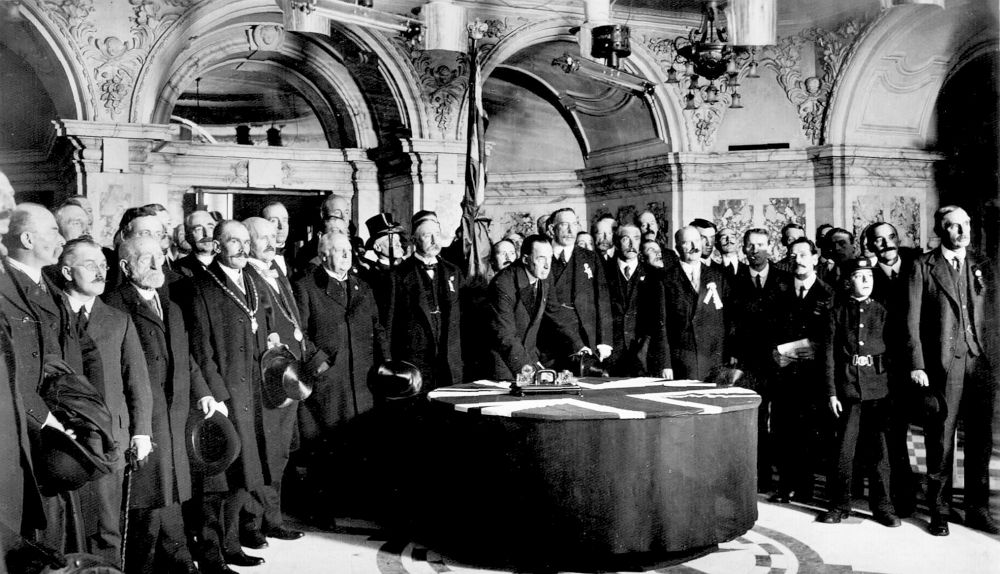
Sir Edward Carson signing the Ulster Solemn Covenant in Belfast City Hall on Ulster Day, 28th September 1912. Also seen are James Craig and Belfast Mayor and Councillors. The table Carson is leaning on is still in Belfast City Hall.

Since the introduction by the Liberal Prime Minister, William Gladstone, of the First Home Rule Bill of 1886, which aimed to establish an Irish legislature in Dublin, Ulster Protestants had been voicing their opposition under the slogan, ‘Home Rule is Rome Rule’. The Bill was defeated in the House of Commons and heavily split the Liberal Party.

The Second Home Rule Bill in 1893 was also introduced by Gladstone. It successfully passed the House of Commons but was overwhelmingly vetoed by the House of Lords.

The Third Home Rule Bill of 1912–1914 was introduced by Prime Minister H. H. Asquith, another Liberal Party leader. (more…)