
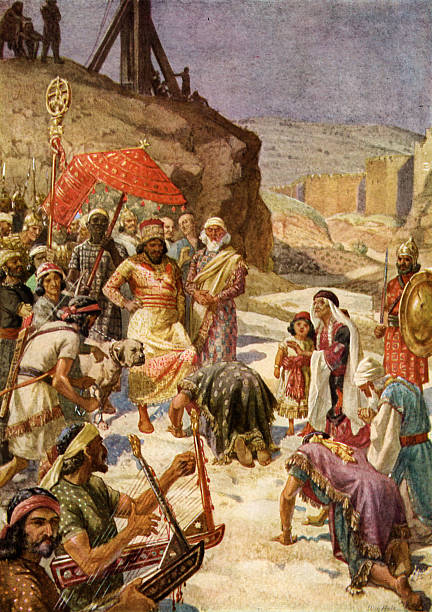
Jeremiah 22: 25 – 26. ‘And I will give thee into the hand of them that seek thy life, and into the hand of them whose face thou fearest, even into the hand of Nebuchadrezzar king of Babylon, and into the hand of the Chaldeans. 26 And I will cast thee out, and thy mother that bare thee, into another country, where ye were not born; and there shall ye die’. Illustration by William Hole 1846 – 1917
“And it came to pass in the seven and thirtieth year of the captivity of Jehoiachin king of Judah, in the twelfth month, on the seven and twentieth day of the month, that Evilmerodach king of Babylon in the year that he began to reign did lift up the head of Jehoiachin king of Judah out of prison; and he spake kindly to him, and set his throne above the throne of the kings that were with him in Babylon; and changed his prison garments: and he did eat bread continually before him all the days of his life. And his allowance was a continual allowance given him of the king, a daily rate for every day, all the days of his life,” 2 Kings 25:27-30.
I read these verses on Wednesday November 12th, as apart of my daily readings. They brought back memories of my days in the Theological Hall of the Free Presbyterian Church. It was in my first year of study that Dr S B Cooke, who lectured in Homiletics, set these verses as a text for his class. That was in 1965.
I have preached on these verses a number of times in different places over the subsequent 60 years. However, I freely acknowledge that much of what I have said would have originated with what Dr Cooke set forth that day in the class, convened in the prayer room of Ravenhill Free Presbyterian Church.
I have visited Dr Cooke in the nursing home in Kilkeel where he and his dear wife, Agnes, reside at present. He has been to me a good and faithful tutor, mentor, counsellor and friend.
First Meeting
When I first met him I was a recent convert to Christ and a very commonplace theological student in need of much instruction! My acquaintance with Dr Cooke was therefore that of a student with a very experienced and honoured preacher of the Gospel.
However, that changed somewhat in 1966. On June 6th of that year there was a Free Presbyterian protest outside the annual General Assembly of the Presbyterian Church in Ireland, in Belfast. It was prompted chiefly by the Presbyterian Church’s very active involvement in the modernistic and ecumenical apostasy flourishing back then.
But the protest was also against the presence of the representative of Éamon de Valera, President of the Republic of Ireland being an invited guest at the Assembly.
De Valera was a commandant of the Irish Volunteers in the Easter Rebellion of 1916 and prominent leader of the later IRA terrorism campaign. In 1966 we of the Free Presbyterian Church believed that it was gravely improper and unscriptural to honour such an unrepentant terrorist and a persecutor of the many Protestants in Ireland who had suffered under him and his terrorist allies, for the previous 50 years!
Court Case
That protest resulted in a court case and charges of ‘unlawful assembly’ being levelled against a number of protesters, including Dr Ian Paisley who led the protest, Rev John Wylie, a senior Free Presbyterian minister and myself, a second year theological student and licentiate minister.
We were found guilty and sentenced to being ‘bound over’ for a period of 2 years, which entailed us giving an undertaking to the court not to engage in any like behaviour during the two-year period. We were also fined, some £40, if I recall correctly.
Committed
Since we, as Free Presbyterian ministers, were quite committed by our ordination oath to continuing such protests against the modernism and ecumenism of the three mainline churches here in Northern Ireland, we refused to sign the ‘rule of bail’.
Consequently, we were committed to Crumlin Road Jail. Dr Paisley was arrested on his way to his Wednesday prayer meeting on July 20th. Rev John Wylie was arrested the next day, Thursday 21st, while on holiday with his wife in Newcastle, and lodged in jail. I was arrested outside Sandown Road Free Presbyterian Church, late on Thursday evening and because it was deemed too late for me to be committed to Crumlin Road jail, I spent the first night of my sentence in Musgrave Street RUC barracks, amidst the drunks arrested that evening! I joined the other two jail birds earlier the next day.
Blessed Stirring
As a result of the stirring that took place in Northern Ireland under God, I solemnly believe, there sprang up a tremendous interest in the message and witness of the Free Presbyterian Church.
When we were released at the end of October, there immediately began a series of meetings and open-air rallies at which the three of us spoke. My diary of that year records meetings and rallies in Moneyrea Orange Hall (October 21st), Kilkeel (22nd), Dundonald ‘Welcome Home Rally’ (23rd), Cabra, later Ballymoney Free Presbyterian Church, (24th), Moneyrea Orange hall again (28th), Armagh (29th), Crossgar Free Presbyterian Church (November 1st) — this continued, almost night after night, well into 1967.
On Saturday, 11th February, in a former shop and store in Lisbellaw, a rally was held. Dr Paisley and Rev John Wylie spoke at the afternoon meeting and Rev William Beattie, a fellow student and chaplain to Dr Paisley during the imprisonment, and myself spoke at the evening service. That was the first meeting out of which sprang Lisbellaw, later Bethel Free Presbyterian Church, Clogher Valley, Coragarry (Co Monaghan), Kilskeery and Kesh Free Presbyterian Churches.
Thus because of the jailing and the aftermath, I was thus thrust forward in a manner that would not have otherwise been the case. I entered into an association with Rev Cooke, Rev John Douglas, Rev Alan Cairns and, of course, Revs Paisley and Wylie, even though I was but a very recent convert and even more recent student studying for the Gospel ministry. These men were the leaders of the work and I was enabled to fellowship with them on a level that ordinarily would not have been the case with a second year theological student. I will ever be thankful to the Lord for that privilege!
To return to the verses at the beginning of the article, I will give the basic outline that was given me in Dr Cooke’s Homiletics class back in 1965.
I. HERE IS A MAN WITH A DAY AND A DATE CONVERSION.
“And it came to pass in the seven and thirtieth year of the captivity of Jehoiachin king of Judah, in the twelfth month, on the seven and twentieth day of the month, that Evilmerodach king of Babylon in the year that he began to reign did lift up the head of Jehoiachin king of Judah out of prison,” verse 27.
What happened to Jehoiachin under the kindness of Evilmerodach, king of Babylon, is a wonderful picture of the spiritual conversion of which all who would enter heaven must experience!
“And said, Verily I say unto you, Except ye be converted, and become as little children, ye shall not enter into the kingdom of heaven,” Matthew 18:3.
“Repent ye therefore, and be converted, that your sins may be blotted out, when the times of refreshing shall come from the presence of the Lord,” Acts 3:19.
The word ‘converted’ carries the meaning of ‘turning back to God from our sins’. It is a change wrought within us by the grace and power of the Holy Spirit.
This same truth is set forth under different terms by the Saviour in John chapter 3.
“Jesus answered and said unto him, Verily, verily, I say unto thee, Except a man be born again, he cannot see the kingdom of God. Nicodemus saith unto him, How can a man be born when he is old? can he enter the second time into his mother’s womb, and be born? Jesus answered, Verily, verily, I say unto thee, Except a man be born of water and of the Spirit, he cannot enter into the kingdom of God,” John 3:3-5.
Carnal man has no understanding of the spiritual nature of true religion. Thus Nicodemus thought of being “born-again” in natural terms!
But it was a new birth wrought through the Word of God as applied by the Holy Spirit. The reference to “water” is a reference to the Word of God as is taught us in Ephesians 5:25-27.
“Husbands, love your wives, even as Christ also loved the church, and gave himself for it; that he might sanctify and cleanse it with the washing of water by the word, that he might present it to himself a glorious church, not having spot, or wrinkle, or any such thing; but that it should be holy and without blemish.”
And again, “Now ye are clean through the word which I have spoken unto you,” John 15:3.
II. THE FIRST ACT OF MERCY TOWARD JEHOIACHIN THE KING ‘LIFTING UP HIS HEAD’.
There is an indication here of the miserable condition of Jehoiachin. Sin brings a person down into misery.
Had not his sins brought him down from the throne of Judah to the darkness of the Babylonian prison cell?
“Jehoiachin was eighteen years old when he began to reign, and he reigned in Jerusalem three months. And his mother’s name was Nehushta, the daughter of Elnathan of Jerusalem. And he did that which was evil in the sight of the LORD, according to all that his father had done. At that time the servants of Nebuchadnezzar king of Babylon came up against Jerusalem, and the city was besieged. And Nebuchadnezzar king of Babylon came against the city, and his servants did besiege it. And Jehoiachin the king of Judah went out to the king of Babylon, he, and his mother, and his servants, and his princes, and his officers: and the king of Babylon took him in the eighth year of his reign,” 2 Kings 24:8-12.
Paul states the case clearly when referring to the former state of the Christians in Ephesus.
“Wherefore remember, that ye being in time past Gentiles in the flesh, . . . that at that time ye were without Christ, being aliens from the commonwealth of Israel, and strangers from the covenants of promise, having no hope, and without God in the world: But now in Christ Jesus ye who sometimes were far off are made nigh by the blood of Christ,” Ephesians 2:11-13.
Mankind seeks to remove any sense of their misery by engaging in that which dulls the pain such misery brings — alcohol, amusement (the etymology of the word is basically, ‘against musing or thinking’) engaging in “serving divers lusts and pleasures,” (Titus 3:3).
Such ‘pleasures’ are short-lived! This Moses understood and so made his choice accordingly.
“Choosing rather to suffer affliction with the people of God, than to enjoy the pleasures of sin for a season,” Hebrews 11:25.
III. FURTHER EVIDENCE OF MERCY WAS THE KING SPEAKING ‘KINDLY TO HIM’.
Prior to this, the king Evilmerodach would have spoken to Jehoiachin and treated him for what he was, a rebel and enemy of his.
In like manner, the Word of God refers to us in our sins as defiers of God whose ways and words have provoked His wrath!
“And you, that were sometime alienated and enemies in your mind by wicked works,” Colossians 1:21. That is what we are in our natural ‘unconverted’ state!
But obedience of and faith in the kind words of the Gospel brings a wonderful change!
“But God commendeth his love toward us, in that, while we were yet sinners, Christ died for us. Much more then, being now justified by his blood, we shall be saved from wrath through him. For if, when we were enemies, we were reconciled to God by the death of his Son, much more, being reconciled, we shall be saved by his life. And not only so, but we also joy in God through our Lord Jesus Christ, by whom we have now received the atonement,” Romans 5:8-11.
What joy entered the heart of Jehoiachin when he heard the kind words of king Evilmerodach!
IV. THE KINDNESS WAS NOT MERELY ‘WORDS’, BUT DRAMATIC CHANGES TO HIS CONDITION CAME ABOUT.
Evilmerodach acted most kindly also. He did “lift up the head of Jehoiachin king of Judah out of prison; and he spake kindly to him, and set his throne above the throne of the kings that were with him in Babylon,” verses 27-28.
The “kings that were with him in Babylon” were other captives, which the Babylonian conquests resulted in their being imprisoned. It seems that though the power of these kings was taken away by the Babylonians, yet some honour and respect was given to them, even in the place of their captivity. But to Jehoiachin was given greater kindness and honour than to any of the rest.
The wonderful prayer of Hannah, 1 Samuel 2:1-10, wonderfully sets forth the merciful and gracious ‘elevation’ the subjects of God’s mercy experience. What Jehoiachin experienced at the hands of Evilmerodach, though illustrative of Gospel mercy, can only fall far short of what it portrays!
“The LORD maketh poor, and maketh rich: he bringeth low, and lifteth up. He raiseth up the poor out of the dust, and lifteth up the beggar from the dunghill, to set them among princes, and to make them inherit the throne of glory: for the pillars of the earth are the LORD’S, and he hath set the world upon them. He will keep the feet of his saints, and the wicked shall be silent in darkness; for by strength shall no man prevail. The adversaries of the LORD shall be broken to pieces; out of heaven shall he thunder upon them: the LORD shall judge the ends of the earth; and he shall give strength unto his king, and exalt the horn of his anointed.”1 Samuel 2:7-10. So said godly Hannah.
What the Lord does for the poor repentant sinner far, far exceeds that experience by Jehoiachin when he was lifted up by Evilmerodach. Think of these words of Hannah: “He raiseth up the poor out of the dust, and lifteth up the beggar from the dunghill, to set them among princes, and to make them inherit the throne of glory,” verse 8.
This is what it is to have your head lifted up by the Lord!
V. THE APPEARANCE OF JEHOIACHIN WAS ALSO CHANGED WONDERFULLY.
“And changed his prison garments,” verse 29.
He was attired from the king’s wardrobe. How different he looked in the robes provided by Evilmerodach!
Again we have a parallel with what happens at conversion. As it was with the repentant prodigal, when he returned, his father commanded: “Bring forth the best robe, and put it on him,” Luke 15:22. This was also illustrative of the blessings of conversion.
Isaiah the prophet spoke of the clothing the converted wear. “I will greatly rejoice in the LORD, my soul shall be joyful in my God; for he hath clothed me with the garments of salvation, he hath covered me with the robe of righteousness, as a bridegroom decketh himself with ornaments, and as a bride adorneth herself with her jewels,” Isaiah 61:10.
Revelation 19:7-8 tells us of the garments of the saints. “Let us be glad and rejoice, and give honour to him: for the marriage of the Lamb is come, and his wife hath made herself ready. And to her was granted that she should be arrayed in fine linen, clean and white: for the fine linen is the righteousness of saints.”
These are the same as the garments of Christ, as seen by Daniel. “Then I lifted up mine eyes, and looked, and behold a certain man clothed in linen, whose loins were girded with fine gold of Uphaz: His body also was like the beryl, and his face as the appearance of lightning, and his eyes as lamps of fire, and his arms and his feet like in colour to polished brass, and the voice of his words like the voice of a multitude,” Daniel 10:5-6.
We are robed in robes of the King of Kings, just as Jehoiachin was clothed in the robes of the Evilmerodach.
Oh, truly “it doth not yet appear what we shall be: but we know that, when he shall appear, we shall be like him; for we shall see him as he is,” 1 John 3:2.
One final thought:
VI. THE BLESSING BESTOWED ON JEHOIACHIN LASTED AS LONG AS HE LIVED.
“And he did eat bread continually before him all the days of his life. And his allowance was a continual allowance given him of the king, a daily rate for every day, all the days of his life,” verses 29-30.
That which begins with the conversion of the sinner lasts forever!
The best known verse in the Bible, which a stupid policeman in England recently alleged could be construed as being in breach of the ‘Hate’ laws, is John 3:16.
“For God so loved the world, that he gave his only begotten Son, that whosoever believeth in him should not perish, but have everlasting life.”
Faith in Christ will bring us “everlasting life”! There is no “perishing” ahead of the Christian. The word means to ‘destroyed’, to be ‘lost’!
The wellbeing of Jehoiachin was safeguarded by the word of the king, as long as he lived.
Likewise, the Christian has the word of the “King of Kings” that they will not be lost.
The Saviour said: “Verily, verily, I say unto you, He that heareth my word, and believeth on him that sent me, hath everlasting life, and shall not come into condemnation; but is passed from death unto life,” John 5:24.
The word “hath” indicates ‘present possession’. The Christian does not have to wait until they die in order to ascertain whether or not they have eternal life. They are told by Christ that they already possess it.
“He that believeth on the Son hath everlasting life: and he that believeth not the Son shall not see life; but the wrath of God abideth on him,” John 3:36.
For the rest of his life, Jehoiachin could enjoy comfort and rest on the basis of the king’s promise.
So the same, but on a more heavenly and spiritual basis, so it is with every Christian.
So it was with Abraham. “Who against hope believed in hope, that he might become the father of many nations, according to that which was spoken, so shall thy seed be. And being not weak in faith, he considered not his own body now dead, when he was about an hundred years old, neither yet the deadness of Sara’s womb: he staggered not at the promise of God through unbelief; but was strong in faith, giving glory to God; and being fully persuaded that, what he had promised, he was able also to perform,” Romans 4:18-21.
Paul was likewise persuaded!
“I am not ashamed: for I know whom I have believed, and am persuaded that he is able to keep that which I have committed unto him against that day,” 2 Timothy 1:12.
Such is the settled peace and contentment regarding eternity that is the possession of the believer!
Of course, it is a sad fact that there are many who, on the basis of their baptism, their church-going or just on their persuasion that there is no God, no heaven, no hell live under a false sense of peace.
What an awakening awaits them in eternity! What an eternal realisation that their folly has brought them to that place “Where their worm dieth not, and the fire is not quenched” Mark 9:48. These figurative expressions describe the eternity of hell’s torments and the anguish and misery of them.
Dear reader, rest not in anything other than the fact that you have obeyed the Gospel call and have entered into the comforts purchased by Christ’s atoning death at the cross and that you have the assurance of God’s pardoning mercy ever witnessed to your soul by the indwelling Holy Spirit.
“For all the promises of God in him are yea, and in him Amen, unto the glory of God by us. Now he which stablisheth us with you in Christ, and hath anointed us, is God; Who hath also sealed us, and given the earnest (the down payment of future and eternal blessings) of the Spirit in our hearts,” 2 Corinthians 1:20-22.
“For we that are in this tabernacle do groan, being burdened: not for that we would be unclothed, but clothed upon, that mortality might be swallowed up of life. Now he that hath wrought us for the selfsame thing is God, who also hath given unto us the earnest of the Spirit. Therefore we are always confident, knowing that, whilst we are at home in the body, we are absent from the Lord: (For we walk by faith, not by sight:) We are confident, I say, and willing rather to be absent from the body, and to be present with the Lord,” 2 Corinthians 5:4-8.
“He that believeth on the Son of God hath the witness in himself: he that believeth not God hath made him a liar; because he believeth not the record that God gave of his Son. And this is the record, that God hath given to us eternal life, and this life is in his Son. He that hath the Son hath life; and he that hath not the Son of God hath not life. These things have I written unto you that believe on the name of the Son of God; that ye may know that ye have eternal life, and that ye may believe on the name of the Son of God. And this is the confidence that we have in him, that, if we ask any thing according to his will, he heareth us: and if we know that he hear us, whatsoever we ask, we know that we have the petitions that we desired of him,” 1 John 5:10-15.
Think on these things, dear reader, and call upon the Lord TODAY for salvation.
“Whosoever shall call on the name of the Lord shall be saved,” Acts 2:21.
Rev Ivan Foster (Rtd)
Monday, 17th November 2025