
“I am set for the defence of the gospel,” Philippians 1:17.
Today, March 27th, 2026, I read Philippians chapter 1 as part of my daily reading from the Holy Scriptures.
Shortly after I was saved and had entered upon my studies for the Gospel ministry back in 1965, I chose these words as my motto text.
I had noted that Dr Ian Paisley usually signed his signature accompanied by the words of Ephesians 6:19.
“And for me, that utterance may be given unto me, that I may open my mouth boldly, to make known the mystery of the Gospel.”
Seeing this, I sought for a text that I might embrace as my motto, watchword and guide for my life.
Summary
I do not recall how it was I came upon this text, likely just as today, it was part of my daily reading back then. It appealed to me as a very suitable summary of the objectives of one who sought to stand for the Lord in the midst of the ecumenical apostasy which was back then beginning to break forth on every hand amongst the three main denominations, the Presbyterian Church in Ireland, the Church of Ireland and the Methodist Church in Ireland.
The words became my companion, my guide and motivation since that time.
Inspiration
These were the words of Paul the Apostle, written under the inspiration of the Holy Spirit. Paul lived out these words all his days as a Christian. He was faithful to this holy determination and, in the end, it cost him his life.
He said of his life’s objective: “For the which cause I also suffer these things: nevertheless I am not ashamed: for I know whom I have believed, and am persuaded that he is able to keep that which I have committed unto him against that day,” 2 Timothy 1:12.
Later in this same epistle he wrote: “For I am now ready to be offered, and the time of my departure is at hand. I have fought a good fight, I have finished my course, I have kept the faith: Henceforth there is laid up for me a crown of righteousness, which the Lord, the righteous judge, shall give me at that day: and not to me only, but unto all them also that love his appearing,” 4:6-8.
He lived and died defending the Gospel!
I. THIS DETERMINATION SHOULD MARK EVERY CHRISTIAN’S LIFE.
1. Of course, it should especially mark the preacher’s disposition. We all, every preacher of the Gospel, should have the heart of David, the shepherd boy, who, when confronted by the blasphemous boasting of Goliath, instantly responded!
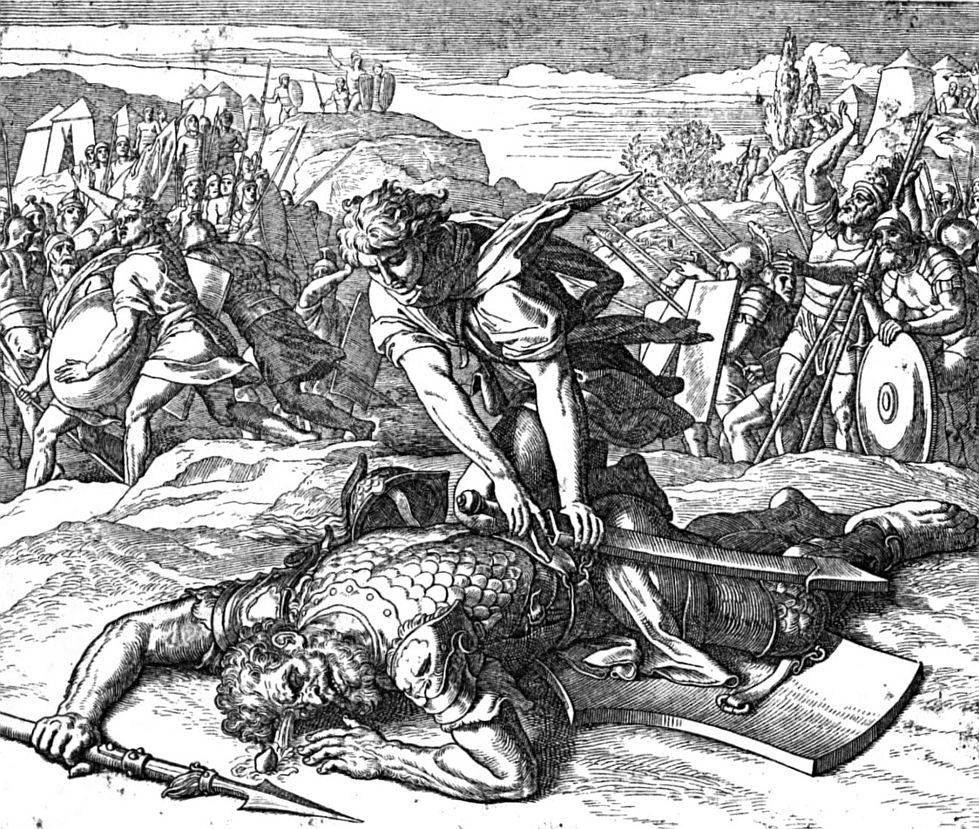
“And David spake to the men that stood by him, saying, What shall be done to the man that killeth this Philistine, and taketh away the reproach from Israel? for who is this uncircumcised Philistine, that he should defy the armies of the living God?” 1 Samuel 17:26.
That instinctive reaction to the Philistine champion’s arrogant defiance of the God of Israel, was followed by the holy determination of the shepherd boy to respond and react to this swaggering, blasphemous braggart.
“And David said to Saul, Let no man’s heart fail because of him; thy servant will go and fight with this Philistine. . . Then said David to the Philistine, Thou comest to me with a sword, and with a spear, and with a shield: but I come to thee in the name of the LORD of hosts, the God of the armies of Israel, whom thou hast defied. This day will the LORD deliver thee into mine hand; and I will smite thee, and take thine head from thee; and I will give the carcases of the host of the Philistines this day unto the fowls of the air, and to the wild beasts of the earth; that all the earth may know that there is a God in Israel. And all this assembly shall know that the LORD saveth not with sword and spear: for the battle is the LORD’S, and he will give you into our hands,” 1 Samuel 17:32, 45-47.
This was no youthful bragging. No, these were words of holy determination to uphold the name and honour of the Lord by going forward in faith, believing the Lord would enable him to defeat the giant.
Note the words he spoke as he charged upon Goliath. “I come to thee in the name of the LORD of hosts, the God of the armies of Israel, whom thou hast defied. This day will the LORD deliver thee into mine hand; and I will smite thee, and take thine head from thee; and I will give the carcases of the host of the Philistines this day unto the fowls of the air, and to the wild beasts of the earth; that all the earth may know that there is a God in Israel.”
These were not the sentiments of an over-confident teenager. They were the words of faith and holy consecration to the cause of the Lord! David could not witness the wicked boasting of Goliath without responding.
So it was with Paul. He lived and died as a Christian ever ready to take on the ‘Goliaths’ of his day!
2. There have ever been Goliaths abroad, defying the people of God and mocking the Lord. There never was a time when ‘Goliath’ did not roar! I recall preaching a message with the title: ‘Goliath Roars on Enniskillen Diamond’! It was centred upon the boastful and wicked statements uttered by various speakers at an Irish Republican protest gathering in Enniskillen.
In essence the statements were but an echo of the defiance of Goliath and the challenging of the cause of God in Ulster.
There have always been Goliaths and there always will be until the finally manifestation of that spirit, personified in the person of the Antichrist!
“And I saw the beast, and the kings of the earth, and their armies, gathered together to make war against him that sat on the horse, and against his army. And the beast was taken, and with him the false prophet that wrought miracles before him, with which he deceived them that had received the mark of the beast, and them that worshipped his image. These both were cast alive into a lake of fire burning with brimstone. And the remnant were slain with the sword of him that sat upon the horse, which sword proceeded out of his mouth: and all the fowls were filled with their flesh,” Revelation 19:19-21.
The Holy Spirit, dwelling in David, in Paul and in the armies of heaven led by the Saviour, react to the challenges of the wicked.
So it has ever been in every generation of God’s people. In these days we are marking the 1951 demonstration of that spirit in Crossgar, when the faithful elders who had invited Ian Paisley to conduct a mission stood with him when they were shut out of their own church hall by the Down Presbytery of the apostate Presbyterian Church in Ireland!
Thus the Free Presbyterian Church was born and thus it will continue to flourish IF THERE IS FOUND STILL THAT HOLY DETERMINATION TO “EARNESTLY CONTEND FOR THE FAITH”!
3. It is clear that Paul was ever in a spiritual frame of readiness to defend the Gospel. ‘I am set’, he says. The word “set” is found in Luke 2:12 and 16. There it is translated as “lying” and it refers to Christ as a babe, “lying in a manger”.
That gives us the meaning of the settled state of Paul’s heart and mind regarding his defence of the Gospel. It was his ‘settled and fixed’ disposition.
It is a very long time ago that I heard Dr Paisley preach upon the text: “Behold his bed, which is Solomon’s; threescore valiant men are about it, of the valiant of Israel. They all hold swords, being expert in war: every man hath his sword upon his thigh because of fear in the night,” Song of Solomon 3:7-8.
He spoke of it being a picture of the ‘bed’ of Holy Scripture, wherein Christ ‘reposed’ Of course, that is so. It is in the Bible we will find the Saviour, even as the Shepherds found Christ “lying in a manger”!
“Search the scriptures; for in them ye think ye have eternal life: and they are they which testify of me,” John 5:39.
On guard
It is our duty to stand around the Holy Scriptures and the Christ revealed there and be ever at the ready to defend His name, His honour and His glory.
They that tamper with the Word of God, show absolutely no reverence for the truth of God and manifest no due fear of Him.
“To the law and to the testimony: if they speak not according to this word, it is because there is no light in them,” Isaiah 8:20.
I have heard of young ministers speaking in a manner I can only term as ‘lacking in reverence’! They seem able to casually dismiss or question statements from the Bible without any consciousness of it being the very Word of God that they treat in such a manner!
That was not the attitude of Paul toward the Gospel!
II. PAUL WAS SEEN AND KNOWN AS AN APOLOGIST FOR THE GOSPEL.
The word translated “defence” is a Greek word, apologia, from which we get ‘apologia’, meaning ‘a formal, written or spoken defence of one’s opinions, beliefs, or actions.’
1. The Gospel is not only to be preached but is to be defended. Lying behind the silence of many professing Christians whenever the Word of God is sneered at and mocked by the enemy, is old fashioned ‘cowardice’!
Paul said: “For I am not ashamed of the Gospel of Christ: for it is the power of God unto salvation to every one that believeth; to the Jew first, and also to the Greek,” Romans 1:16.
Being ashamed of the Words of Christ is a most dreadful sin!
“Whosoever therefore shall be ashamed of me and of my words in this adulterous and sinful generation; of him also shall the Son of man be ashamed, when he cometh in the glory of his Father with the holy angels,” Mark 8:38.
The Saviour’s response to a manifestation of being ashamed of Him, clearly indicates how appalling is just such an attitude!
2. The measure of our defence of the Gospel may be seen in Paul’s response to the slanders of Elymas! How far should we go in opposing ecumenists and apostates? “But Elymas the sorcerer (for so is his name by interpretation) withstood them, seeking to turn away the deputy from the faith. Then Saul, (who also is called Paul,) filled with the Holy Ghost, set his eyes on him, And said, O full of all subtilty and all mischief, thou child of the devil, thou enemy of all righteousness, wilt thou not cease to pervert the right ways of the Lord? And now, behold, the hand of the Lord is upon thee, and thou shalt be blind, not seeing the sun for a season. And immediately there fell on him a mist and a darkness; and he went about seeking some to lead him by the hand,” Acts 13:8-11.
The weapon Paul used against this blasphemer was “not carnal” or of the flesh, but it was of God and “mighty through God to the pulling down of strong holds,” 2 Corinthians 10:4.
Power was given to Paul, as an apostle of Christ by the Holy Ghost, to smite this man blind for a season or period of time. Long enough that both he and those who witnessed the smiting knew that it was of God.
Paul told Elymas a few home truths about his character and who it was he was serving when he sought to “turn away the deputy from the faith”. The deputy, or ‘Roman profound’ for that district, was “Sergius Paulus, a prudent man; who called for Barnabas and Saul, and desired to hear the word of God,” verse 7.
He was anxious to hear the Word of God and this “sorcerer”, a child, a servant of the devil and enemy of all righteousness, tried to turn the man away from hearing the Gospel.
The judgment of God fell upon him as Paul stoutly resisted this perverter of God’s truth.
Such strong defence of the Gospel not only stopped this false prophet’s activities but it led to the conversion of the deputy!
“Then the deputy, when he saw what was done, believed, being astonished at the doctrine of the Lord,” verse 12.
3. The Free Presbyterian Church was most active in soul winning when it was publicly and courageously determined to confront the enemies of the Gospel! It was a time when we took to heart the exhortation of Jude: “Beloved, when I gave all diligence to write unto you of the common salvation, it was needful for me to write unto you, and exhort you that ye should earnestly contend for the faith which was once delivered unto the saints,” Jude 1:3.
Question
Such a witness saw hundreds saved and many new congregations formed. When was the last time YOU heard your minister EARNESTLY CONTEND FOR THE FAITH, in a fashion like that pursued in the 1960s and 1970s?
Is there not a lesson here regarding the present stagnation of our pulpit and pews?
It is the observation of very many of our members, both the young but particularly those old enough to remember days of protests, that our pulpits are largely silent in the face of every increasing departure on the part of the ecumenical denominations and the rapid descent into immorality of our society.
This ought not to be!
Ordination
I recall vividly still the emphasis that Dr Paisley laid upon the opening verses of Jeremiah chapter 1, when he preached at my ordination and installation as minister in Lisbellaw back in April 1968.
“Then the LORD put forth his hand, and touched my mouth. And the LORD said unto me, Behold, I have put my words in thy mouth. See, I have this day set thee over the nations and over the kingdoms, to root out, and to pull down, and to destroy, and to throw down, to build, and to plant,” Jeremiah 1:9-10.
The sequence of events in the prophet’s life as a result of the Lord’s touch upon his mouth and the Lord putting His words in the prophet’s mouth are very significant!
“See, I have this day set thee over the nations and over the kingdoms, to root out, and to pull down, and to destroy, and to throw down, to build, and to plant.”
Six activities: four were to demolish the wickedness that was abroad and two were the building up again of truth and righteousness.
The Lord emphasises this sequence of events in advancing the Gospel cause with another analogy, this time an agricultural one.
“Sow to yourselves in righteousness, reap in mercy; break up your fallow ground: for it is time to seek the LORD, till he come and rain righteousness upon you,” Hosea 10:12.
We do not need to be farmers to know that ploughing comes before sowing! Ploughing is a breaking up of the ground so that the growth already occupying the ground is dislodged and its hold broken and room, as it were, made for the good seed that is to take the place of that formerly controlling the ground.
The above verse was blessed to me in a mission message, preached by Dr Paisley in September 1964, in a little hall in Foundry Street in east Belfast.
Free Presbyterian ministers and elders should note the order and the emphasis that the Lord requires today!
Let us be up and ploughing the fields and uprooting and destroying the hold that the weeds of ecumenical lies and false doctrine have upon the mind of the people of Ulster!
III. PLEASE NOTE WHAT IT WAS PAUL WAS SET TO DEFEND.
“I am set for the defence of the gospel.”
I recall phoning the local Lisbellaw Methodist minister one time back in the late 1960s, when there was a particular controversy raging within the Methodist denomination. I phoned to ask him why he was not speaking out and coming to the defence of the Gospel that was under attack in his denomination. I knew him to be a true evangelical.
His response to me was: ‘I don’t need to defend the Gospel. The Lord will look after it Himself!’
I then asked him why Paul said what he did in our text, if there was no requirement of God’s servants to come to the defence of the Gospel?
He had no answer!
1. What we are to defend is what Christ came into this world to declare. “And Jesus went about all Galilee, teaching in their synagogues, and preaching the gospel of the kingdom, and healing all manner of sickness and all manner of disease among the people,” Matthew 4:23.
That is the first mention of the word “Gospel” in the New Testament.
It was the message He wanted all to hear and believe. Thus He “went about all Galilee, teaching in their synagogues”.
This “Good News” is what all men need to hear. It is the ONLY MESSAGE that will direct sinners to heaven!
It is significant that His preaching was accompanied by wonderful works of healing! The Word of Christ has brought healing more wonderful than that healing He wrought in order to show His power and the truth of His claim to be the Son of God.
I think I am correct in saying that those the Saviour healed during His ministry, and who trusted in Him for salvation, eventually succumbed to death and lie yet in the dust of Israel awaiting the day of His glorious return and the resurrection of the dead in Christ.
But there is a healing that is wrought through the Word of Christ that eternally delivers from death!
“Jesus said unto her, (Martha) I am the resurrection, and the life: he that believeth in me, though he were dead, yet shall he live: and whosoever liveth and believeth in me shall never die,” John 11:25-26.
It is that Word that we are called upon to defend!
2. What we are to defend is what Christ came into this world to die in order to obtain! The eternal life that springs from the Word of Christ cost the Son of God His life.
That was seen in the Saviour’s consoling of the two sad travellers on the road to Emmaus.
“Then he said unto them, O fools, and slow of heart to believe all that the prophets have spoken: ought not Christ to have suffered these things, and to enter into his glory? And beginning at Moses and all the prophets, he expounded unto them in all the scriptures the things concerning himself,” Luke 24:25-27.
They joyfully confessed the wonderful impact His words had upon their hearts.
“And it came to pass, as he sat at meat with them, he took bread, and blessed it, and brake, and gave to them. And their eyes were opened, and they knew him; and he vanished out of their sight. And they said one to another, Did not our heart burn within us, while he talked with us by the way, and while he opened to us the scriptures?” Luke 24:30-32.
Prophets
What the Saviour opened unto these disciples has ever been the theme of “all that the prophets have spoken”!
“Who hath believed our report? and to whom is the arm of the LORD revealed? For he shall grow up before him as a tender plant, and as a root out of a dry ground: he hath no form nor comeliness; and when we shall see him, there is no beauty that we should desire him. He is despised and rejected of men; a man of sorrows, and acquainted with grief: and we hid as it were our faces from him; he was despised, and we esteemed him not. Surely he hath borne our griefs, and carried our sorrows: yet we did esteem him stricken, smitten of God, and afflicted. But he was wounded for our transgressions, he was bruised for our iniquities: the chastisement of our peace was upon him; and with his stripes we are healed. All we like sheep have gone astray; we have turned every one to his own way; and the LORD hath laid on him the iniquity of us all. He was oppressed, and he was afflicted, yet he opened not his mouth: he is brought as a lamb to the slaughter, and as a sheep before her shearers is dumb, so he openeth not his mouth. He was taken from prison and from judgment: and who shall declare his generation? for he was cut off out of the land of the living: for the transgression of my people was he stricken. And he made his grave with the wicked, and with the rich in his death; because he had done no violence, neither was any deceit in his mouth. Yet it pleased the LORD to bruise him; he hath put him to grief: when thou shalt make his soul an offering for sin, he shall see his seed, he shall prolong his days, and the pleasure of the LORD shall prosper in his hand. He shall see of the travail of his soul, and shall be satisfied: by his knowledge shall my righteous servant justify many; for he shall bear their iniquities. Therefore will I divide him a portion with the great, and he shall divide the spoil with the strong; because he hath poured out his soul unto death: and he was numbered with the transgressors; and he bare the sin of many, and made intercession for the transgressors,” Isaiah 53:1-12.
“I am the good shepherd: the good shepherd giveth his life for the sheep. But he that is an hireling, and not the shepherd, whose own the sheep are not, seeth the wolf coming, and leaveth the sheep, and fleeth: and the wolf catcheth them, and scattereth the sheep. The hireling fleeth, because he is an hireling, and careth not for the sheep. I am the good shepherd, and know my sheep, and am known of mine. As the Father knoweth me, even so know I the Father: and I lay down my life for the sheep,” John 10:11-15.
Heaven resounds with words of praise, centred upon the Saviour’s sacrifice.
“And they sung a new song, saying, Thou art worthy to take the book, and to open the seals thereof: for thou wast slain, and hast redeemed us to God by thy blood out of every kindred, and tongue, and people, and nation,” Revelation 5:9.
Unbelief and Ignorance
He repeatedly emphasised that this was the purpose of His coming into this world. Sadly, at the first, the disciples just did not understand the very heart of the Gospel message.
“Then he took unto him the twelve, and said unto them, Behold, we go up to Jerusalem, and all things that are written by the prophets concerning the Son of man shall be accomplished. For he shall be delivered unto the Gentiles, and shall be mocked, and spitefully entreated, and spitted on: and they shall scourge him, and put him to death: and the third day he shall rise again. And they understood none of these things: and this saying was hid from them, neither knew they the things which were spoken,” Luke 18:31-34.
It was unbelief and a lack of understanding of the purpose of Christ’s death that caused the disciples to forsake Him and likewise it is like unbelief and ignorance that keeps ministers silent when they should be “earnestly contending for the faith” and setting themselves to defend the Gospel!
We have an explanation given us of the reason why the disciples rejected the news of the Saviour’s resurrection.
“Then cometh Simon Peter following him, and went into the sepulchre, and seeth the linen clothes lie, and the napkin, that was about his head, not lying with the linen clothes, but wrapped together in a place by itself. Then went in also that other disciple, which came first to the sepulchre, and he saw, and believed. For as yet they knew not the scripture, that he must rise again from the dead. Then the disciples went away again unto their own home,” John 20:6-10.
John is said to have entered the sepulchre and “he saw, and believed”. What he believed was Mary Magdalene’s report, which at the first had not been believed by the disciples.
“Then she runneth, and cometh to Simon Peter, and to the other disciple, whom Jesus loved, and saith unto them, They have taken away the Lord out of the sepulchre, and we know not where they have laid him,” verse 2.
But John and the other disciples did not yet understand the truth of the Saviour’s resurrection.
3. What we are to defend is that which is beyond valuation! The Saviour defined His words. “The words that I speak unto you, they are spirit, and they are life,” John 6:63.
Peter succinctly informs us that he and others amongst the twelve, excluding Judas of course, understood the divine character of the Saviour’s words, when he replied to the Saviour’s question.
“From that time many of his disciples went back, and walked no more with him. Then said Jesus unto the twelve, Will ye also go away? Then Simon Peter answered him, Lord, to whom shall we go? thou hast the words of eternal life. And we believe and are sure that thou art that Christ, the Son of the living God,” John 6:66-69.
How precious are the “words of eternal life”? The Psalmist gives us a true evaluation of the truth of God.
“The law of thy mouth is better unto me than thousands of gold and silver,” Psalm 119:72.
“Therefore I love thy commandments above gold; yea, above fine gold,” Psalm 119:127.
Value
Rightly understanding the value of the Gospel, Paul was ready therefore to guard it and defend it!
It was for this reason that Moses acted as he did. “By faith Moses, when he was come to years, refused to be called the son of Pharaoh’s daughter; choosing rather to suffer affliction with the people of God, than to enjoy the pleasures of sin for a season; esteeming the reproach of Christ greater riches than the treasures in Egypt: for he had respect unto the recompence of the reward. By faith he forsook Egypt, not fearing the wrath of the king: for he endured, as seeing him who is invisible,” Hebrews 11:24-27.
A like evaluation of God’s Word has persuaded millions to sacrifice their belongings, reputation, comforts, aye, even their lives rather than give up the Gospel or deny its truth!
I believe that I can honestly say that there was a like commendable spirit in the hearts of our Free Presbyterian forefathers who stepped out of the apostasy seventy five years ago to join Christ “without the camp, bearing his reproach,” Hebrews 13:13.
May it please the Lord to renew and revive that spirit amongst us as those events are commemorated this year.
Rev Ivan Foster (Rtd)
Wednesday 1st April 2026