
Some photographs from that time of contending for the Gospel
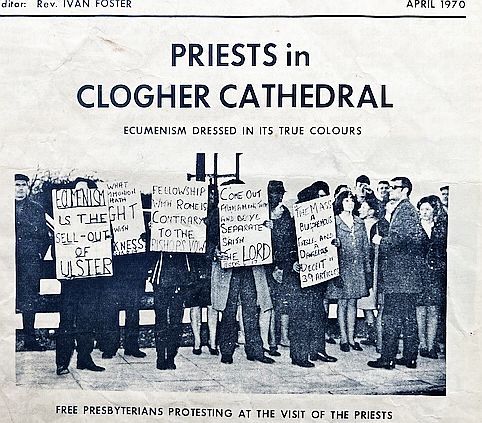
The protest took place at the installation of Richard Hanson as Bishop of Clogher, on March 17th, 1970.
The protest brought about the ejecting of us from of a local Orange Hall, Andrews Wood hall, where I was conducting a Gospel mission. The mission continued however, and by the end of April a Free Presbyterian hall had been erected and some months later that year, Clogher valley Free Presbyterian Church was constituted in the hall.
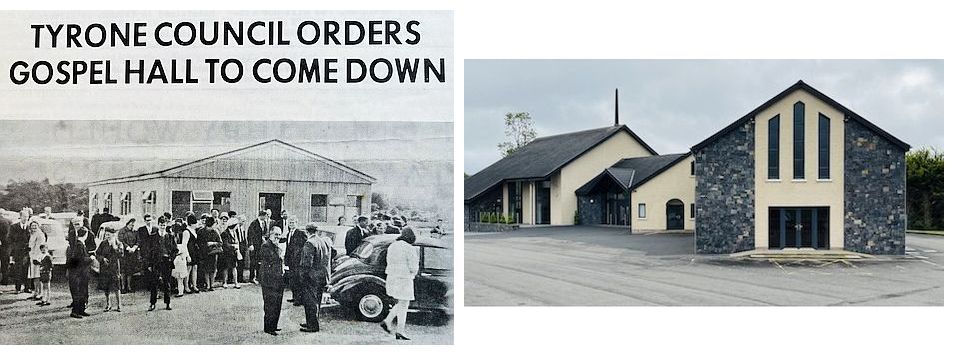
Despite the efforts of local ecumenists and their roping in of some Tyrone County Council officials to aid them, their demand that the hall be taken down and removed, failed.
It can be seen that a hall had been erected and was in use for regular services by June. Many years ago, the hall was replaced by a beautiful permanent building.
The Gospel outreach in the Spring of 1970 in Clogher Valley was the first of a number of missions undertaken by Lisbellaw Free Presbyterian Church that resulted in a permanent Gospel witness in the area.
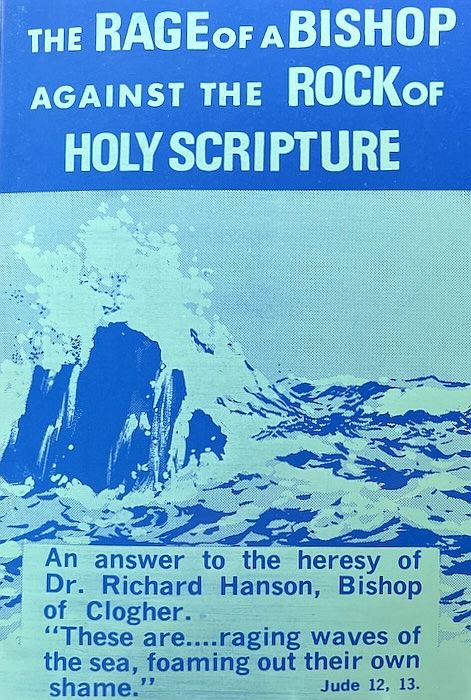
AN ANSWER TO FOUR LECTURES DELIVERED IN ENNISKILLEN CATHEDRAL BY THE BISHOP OF CLOGHER RICHARD HANSON
by
REV. IVAN FOSTER
Minister of Lisbellaw Free Presbyterian Church
Published as a booklet in 1970
The rage of the Bishop against the rock of Holy Scripture
Chapter V
The Second Coming of Christ – Were the early Christians mistaken?
To further his claim that Christianity has changed, the Bishop tries to imbue his audience with the idea that the early Christians and apostolic writers believed that the Lord Jesus Christ was going to return at a very early date. When this did not happen he says that there was a change of thinking concerning the Second Coming of Christ. To knock this argument down all we have to do is pour a little of the “water of the Word” upon the Bishop’s sandy foundation and his little house of false reasoning will sink out of view. The question then is this: Did the early Christians believe that Christ was to return in their day and were they encouraged to believe this by the writers of the New Testament? Our answer is “No”, but of course the Bishop’s would be “Yes”.
In his second lecture he states: “But the greatest difference of all facing the Church of the 2nd century has yet to be mentioned. By the year 150 it had become unmistakably clear to everybody that the Second Coming of our Lord Jesus Christ was not likely to take place in the immediate future . . . St. Paul’s letters are, of course, the earliest books of the New Testament. From every one of the letters which we can with confidence attribute to him (he never misses a chance to spread doubt, does he?) we gain a strong impression that he expects the arrival of Christ in his lifetime or immediately afterward. The earliest of the Gospels, that of Mark, shows the same intense expectation of an almost immediate arrival of Christ. It is only in Mark that we find the words attributed to Jesus: “There be some of those standing by who shall not taste of death till they see the kingdom of God coming in power” (Mark 9 : 1).
Firstly does Paul give the impression that he expected the coming of Christ in his own lifetime or immediately afterwards? Listen to Paul’s own words found in II Thess. 2 : 1 – “Now we beseech you, brethren, by the coming of our Lord Jesus Christ, and by our gathering together unto him, that ye be not soon shaken in mind, or be troubled, neither by spirit, nor by word, nor by letter as from us, as that the day of Christ is at hand”.
Paul says, “Don’t let anyone fool you into thinking that the day of the Lord is at hand”. Well, Bishop, what do you say to that? Perhaps you never read II Thess. 2?
There is more: “Let no man deceive you by any means: for THAT DAY SHALL NOT COME EXCEPT there come a falling away first, and that man of sin is revealed, the son of perdition”.
This is what Paul believed. A falling away from the faith and a revealing of the Antichrist must come before Christ’s Second Advent. The Bishop speaks of a “STRONG IMPRESSION”. Well, here is a STRAIGHTFORWARD EXPOSITION of Paul’s teaching concerning the Second Coming, and it is not what the Bishop stated it to be. Paul’s second epistle to the Thessalonians was written with the motive of combating any false teaching concerning the near coming of Christ. Some had stopped working because of the spreading of the falsehood that Christ was soon to come.
“For even when we were with you, this we commanded you, that if any would not work, neither should he eat. For we hear that there are some which walk among you disorderly, WORKING NOT at all, but by busybodies. Now them that are such we command and exhort by our Lord Jesus Christ, that with quietness they work, and eat their own bread” (II Thess. 3 : 10-12).
Paul is actually writing against the soon arrival of Christ by urging those who had stopped working due to premature expectations to resume their work. Where the Bishop got his strong impression from is a mystery. He certainly did not get it from Paul. This is but an example of how wicked men twist the Scriptures to deceive.
“I know that after my departing shall grievous wolves enter in among you, not sparing the flock. Also of your own selves shall men arise speaking PERVERSE THINGS, to draw away disciples after them” (Acts 20 : 29-30).
Paul did not expect the arrival of Christ immediately after his own departure, but he did expect the RISE OF FALSE TEACHERS WITH PERVERSE TONGUES, men like Dr. Richard Hanson.
The Bishop’s ignorance of the Bible
Secondly we consider the verse Dr. Hanson quoted from Mark 9. “There be some of them that stand here, which shall not taste of death, till they have seen the kingdom of God come with power” (Mark 9:1).We are told first all that these words of Christ appear only in Mark. Anyone who cares to look up Matthew 16 : 28 and Luke 9 : 27 will see that this is not true. Both Matthew and Luke also record this statement by the Saviour. I will judge the Bishop charitably and assume that he just never bothered to read the Book that he attacks so vehemently. Perhaps if men like the Bishop burned the books that they have – written by the Bible-haters of the world – and read The Book, their chants of criticism would be changed into a Psalm of praise.
The Bishop is attempting to establish that early Christians expected the Saviour in their day. Here is proof, he says of his claims. But does the verse teach us that the Second Coming was expected soon? If it was, CHRIST WAS EITHER MISTAKEN OR HE DELIBERATELY DECEIVED HIS DISCIPLES, as these are His words. The Saviour’s meaning is, I believe, much simpler, but just as repugnant to the Bishop no doubt. The key words are “taste of death”. If they simply mean “to die” then the Bishop is right, but if they mean tasting the consequences of death then the meaning of the words is quite different to that placed upon them by Dr. Hanson. It would then mean that there were some standing in Christ’s presence who would not taste the full consequences of God’s judgment until after Christ’s Second Coming, when sinners shall receive the just recompense of their sinful life (Rev. 20 : 12-15.) Do these words “taste death” mean more than just physical death? We find this same word in John 8 : 51. The Lord Jesus has just said, “Verily, verily, I say unto you, If a man keep my saying, he shall never see death”. The Jews accuse Him of having a devil, because, say they, “Abraham is dead, and the prophets; and thou sayest, If a man keep my saying, he shall never TASTE of death”. The Saviour obviously was not saying that whoever believed on Him would not die physically, but that he would never see or taste that which follows death for the unconverted – JUDGMENT. “It is appointed unto man once to die, but after this the judgment” (Hebrews 9 : 27). Psalm 91 : 8 states this doctrine plainly: “Only with thine eyes shalt thou behold and see the reward of the wicked”. Why will some only SEE judgment, whereas others will TASTE judgment? Hebrew 2 : 9 supplies the answer: “But we see Jesus, who was made a little lower than the angels for the suffering of death, crowned with glory and honour; that he by the grace of God should TASTE DEATH for every man”. On the cross Christ tasted death for sinners. This does not merely mean that He died, but rather that He bore the full consequences of our sins. “He was wounded for our transgressions, he was bruised for our iniquities, the chastisement of our peace was upon him; and with his stripes we are healed” (Isaiah 53 : 5). Mark 9:1 does not then refer to the Coming of Christ within the lifetime of some standing near Christ, but something completely different. Christ is teaching the unconverted sinners within His hearing that His coming will mean judgment and the full taste of death for them.
Thus one more of the Bishop’s evidences crumbles beneath the glare of Biblical scrutiny. If he thinks that the thin veneer of scholarly eloquence is sufficient to hide the old lie of hell then he has another think coming.