
Some photographs from that time of contending for the Gospel
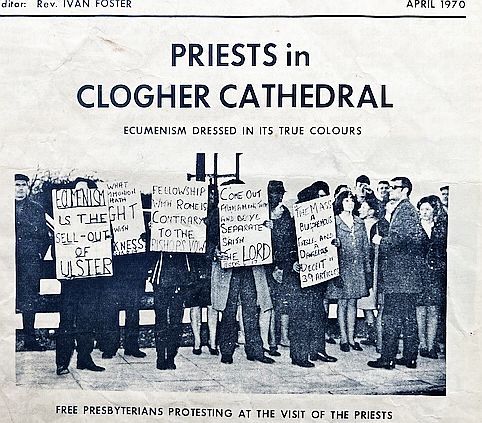
The protest took place at the installation of Richard Hanson as Bishop of Clogher, on March 17th, 1970.
The protest brought about the ejecting of us from of a local Orange Hall, Andrews Wood hall, where I was conducting a Gospel mission. The mission continued however, and by the end of April a Free Presbyterian hall had been erected and some months later that year, Clogher valley Free Presbyterian Church was constituted in the hall.
Despite the efforts of local ecumenists and their roping in of some Tyrone County Council officials to aid them, their demand that the hall be taken down and removed, failed.
It can be seen that a hall had been erected and was in use for regular services by June. Many years ago, the hall was replaced by a beautiful permanent building.
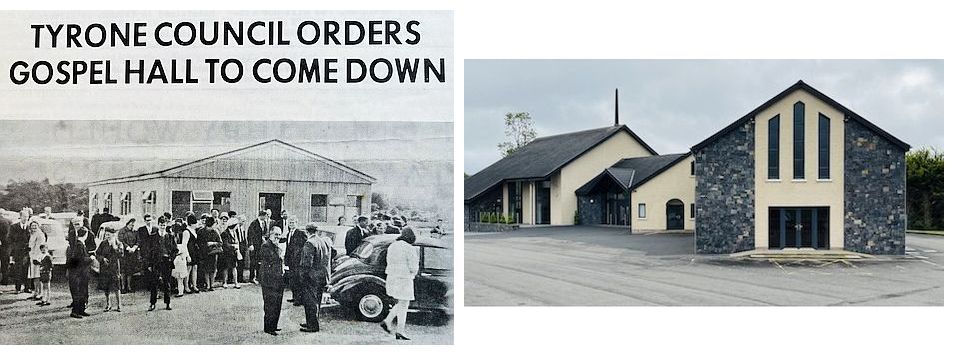
The Gospel outreach in the Spring of 1970 in Clogher Valley was the first of a number of missions undertaken by Lisbellaw Free Presbyterian Church that resulted in a permanent Gospel witness in the area.
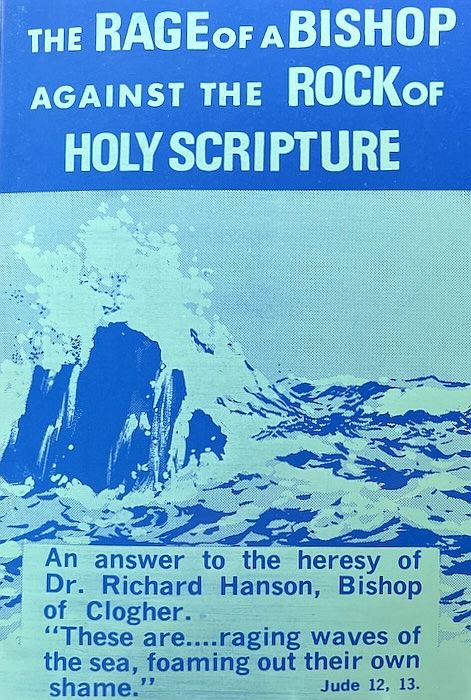
AN ANSWER TO FOUR LECTURES DELIVERED IN ENNISKILLEN CATHEDRAL BY THE BISHOP OF CLOGHER RICHARD HANSON
by
REV. IVAN FOSTER
Minister of Lisbellaw Free Presbyterian Church
Published as a booklet in 1970
The rage of the Bishop against the rock of Holy Scripture
Chapter III
The Authenticity of the Books of the Bible
Like all enemies of truth before him the Bishop of Clogher first of all sets the sights of his scholastic pea-shooter against the Word of God. The Word of God is the great barrier to all such as Dr. Hanson who wish to abolish fundamental Christianity.
Here is what he says concerning Paul’s pastoral epistles, i.e., epistles to Timothy and Titus: “… the pastoral epistles (which I assume to be written not by Paul but by somebody living early in the second century)”. (Lecture 2, paragraph 3.) He also attacks the authenticity of John’s Gospel. “St. John’s Gospel, which was certainly not written by John the Apostle, though it may have originated from a place where traditions about John were treasured.” (Lecture 2, paragraph 4.) Referring to the Second Epistle of Peter, he pontificates with great audacity: “Which is not, of course, by St. Peter.” (Lecture 2, paragraph 3.) Thus the Bishop has left us with a New Testament containing at least five forgeries. If the Bishop can substantiate his assertions he has of course very good reasons for changing doctrines based upon forged epistles. BUT HE DOES NOT AND CANNOT SUBSTANTIATE HIS CLAIMS.
Before we refute the errors of Dr. Hanson perhaps we would consider the supposition: “What if the Bishop is right and these epistles are forgeries?”
1. The first fact to strike us is that if we accept the assertions of Dr. Hanson then these epistles are artful forgeries, written for the express purpose of deceiving. Is it possible that writings of such a gracious and sober nature, breathing such a noble spirit of love and goodness, containing such resolves of holiness and moral courage, and having no apparent object other than the well-being of the Christian societies to which they refer; is it possible, I repeat, that such writings were written with a pen dipped in the inkwell of lies and falsehood? To me it is impossible.
2. If these are forgeries then what right have we to believe that the rest of the Bible is authentic, since the method of proving the authenticity of these disputed epistles is basically the same as that used to prove the genuineness of the other books of the Bible? IF THE BISHOP IS RIGHT WE HAVE NO BASIS FOR BELIEVING OR RECEIVING ANY PART OF THE SCRIPTURES. If the Bishop is honest and carries his argument to its logical conclusion then he DOES NOT BELIEVE ANY PART OF THE BIBLE IS A GENUINE REVELATION OF GOD. His teaching of course implies this very thing. In his third lecture he claims that historical criticism has had a great effect upon the Bible.
“The story of Adam and Eve in the Garden of Eden could no longer be regarded as history. The Law Books of the Old Testament were not written all at one time by Moses, but are the result of a gradual process produced by anonymous contributors over a long period.”
Bible destroyed
Thus we, if we are to believe the Bishop, cannot believe the first five books of the Bible to be a revelation from God. In his first lecture the Bishop plainly denies the Divine origin of the Bible by stating that the documents of the Bible have no more historical authority than any other historical documents of their time. In other words they are NOT A DIVINE REVELATION FROM GOD.
The conclusion we draw is this – we have no means of knowing God, if, and praise God it is only if the Bishop is right. Man can only know about God that which God reveals about Himself. Moses said, “If I have found grace in thy sight, shew me now thy way, that I may know thee”. God must reveal Himself before we can know Him. If we have no God-given revelation then all our doctrines and beliefs concerning God are MERE SPECULATION. All we can honestly be is either an atheist and refuse to believe that there is a God and put Creation down to a mere ACCIDENT, or a pantheist and see God revealing Himself in nature. The Bishop of Clogher leaves us with the choice of NO GOD or THE UNKNOWN GOD. I wonder which the Bishop has avowed as his true faith? Episcopalian by outward profession, but what is the religion of his heart?
In refuting the Bishop’s claims concerning the Epistles of Paul and Peter and the Gospel of John we shall limit our comments to the Gospel of John. We do this for the following reasons:
1. In Lecture 2, paragraph 4, the Bishop states that he is “certain” that this book is not by the Apostle John. If we can show that the Bishop’s “certainties” are as trustworthy as the eyesight of a blindfolded bat, then I am sure you will realise the worthlessness of the rest of his theories.
2. The Gospel of John is the Gospel which above all others sets forth the Deity of the Lord Jesus Christ. It is the Gospel of the Son of God. For this reason it has become the target of sceptical criticism. The critics are guided by similar counsel to that given by Ahithophel to the enemies of King David: “Smite the King only” (II Samuel 17:2). If they can destroy this pillar of Christian doctrine then the whole edifice shall fall, whereas if we can vindicate the genuineness of this Gospel then we can be assured of defeating the lesser assaults of the critics and of the Bishop.
Is the fourth Gospel the work of John or is it the work of an unknown writer? Is the Bishop right or wrong? We will give you proof that the Bishop is FALLIBLE and has made a mistake. We shall not allow ourselves to be intimidated by the tone of haughty assurance affected by Dr. Hanson. Goliath also adopted such a tone and we know what happened to him.
History of the attack
The first serious attack upon this Gospel came in the year 1792 from an English theologian called Evanson. The opinion of Evanson was taken up by some theologians in Germany, namely Schmidt, Cludius, Ballestädt and Horst. The birthplace of the Reformation had become the breeding ground of scepticism and baneful criticism. The Garden of Eden had become the cradle of death. Up to that time, apart from some insignificant criticism about the end of the 17th century, the only attempt to disprove the authenticity of the Gospel came from a group who attributed the Gospel to one Cerinthus who was John’s adversary at Ephesus. But the early Church leaders who were in a position to know, received it as John’s writings. For nearly 1800 years then Christendom believed this to be John’s work. This is a significant point in the discussion. The opinion of the early Church fathers coupled with the learning of theologians of many centuries weighs heavily on the side of the genuineness of this Gospel.
While these attacks were going on the defenders were not idle. Like the inhabitants of a fortress upon which the security of a whole country depended, they answered the enemies’ volley decisively and to good effect. One of the most concise discussions proving John’s authorship is that set forth by a former Bishop of Durham, B. F. Westcott, D.D., D.C.L. Space prohibits me from quoting from him at any great length, but we shall quote a short portion. We quote from his fifth argument under the heading, “The indirect evidence of the Gospel as to its authorship”, as an illustration of the cogency of the arguments put forward. After proving that only an Apostle would have the opportunity to record the thoughts of the Lord Jesus and of the other apostles (see John 2 :11, 17, 22; 6 : 6, 61, 64, as examples of this intimate knowledge), Dr. Westcott goes on:
“If the writer of the fourth Gospel was an Apostle, does the narrative indicate any special Apostle as the writer? In the Epilogue (21 : 24) the authorship of the book is assigned, as we shall see afterwards, to the “disciple whom Jesus loved”. This disciple appears under the same title twice in the narrative of the Passion (13 : 23; 19 : 26), as well as twice afterwards (21 : 7, 20), and once in connection with St. Peter under a title closely resembling it (20 : 2). He is known to the high-priest (18 : 15), and stands in very close relationship with St. Peter (13 : 24, 20 : 2, 21 : 7; comp. 18 : 15; Acts 3). Though his name is not mentioned, there is nothing mysterious or ideal about him. He moves among the other Apostles quite naturally, and from the enumeration (21 : 2; comp. 1 :35 ff.) of those present at the scene described in the last chapter, it follows that he must have been either one of the sons of Zebedee, or one of the two other disciples not described more particularly.
If now we turn to the Synoptic narrative we find three disciples standing in a special sense near to Jesus – Peter and the sons of Zebedee, James and John. There is then a strong presumption that the Evangelist was one of these St. Peter is out of the question. Of the two sons of Zebedee , James was martyred very early (Acts 12 : 2), so that he could not have been the author of the Gospel. John, therefore, alone remains; and he completely satisfies the conditions which are required to be satisfied by the writer, that he should be in close connection with St. Peter, and also one admitted to peculiar intimacy with the Lord.”
How clearly the Bible scholar sets out the undesigned coincidences which point conclusively to John’s pen. Good Dr. Westcott goes on to produce a mass of evidences to prove the authenticity of the Gospel in a most indisputable way. From within the pages of the Gospel itself he brings out evidences, rock hard in their indestructibility. The Bishop of Clogher attacks this Gospel with puny darts, manufactured within the boundaries of his depraved reasoning. We have but to hold up this shield forged by the late Bishop of Durham, the steel of which, tempered by sanctified learning and scholarship, can turn the keenest point that hell can sharpen and hone.
A similar examination of the other epistles which Dr. Hanson high-handedly dismisses to the dunghill of absurdity, will yield the same INDISPUTABLE PROOF THAT THEY ARE THE WORK OF THE AUTHORS THAT ORTHODOX THEOLOGIANS ACCREDITED THEM TO.
We shall allow Dr. Hanson to wander off down the road which leads to a night unlit by the revelation of God, which shines as a light in a dark place. (II Peter 1:19.)
Saturday 20th June, 2026
Part 5 will follow next Saturday DV.